
DTG Printing for Full-Colour Artwork
DTG printing sprays water-based ink directly into the fabric, like an inkjet printer for garments. It is the only method that handles photographs, gradients and unlimited colours without a separate screen for each one, and it runs from 30 pieces per style.
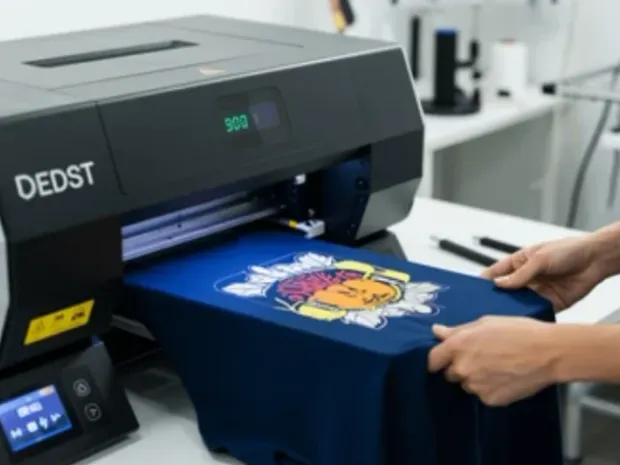
What DTG printing actually is
DTG stands for direct to garment. The printer lays ink directly onto the fabric surface rather than through a screen, which removes the per-colour setup that makes screen printing expensive for complex artwork.
Because there are no screens, a twelve-colour photographic design costs the same to print as a two-colour one. That makes DTG the obvious choice for detailed illustration, photography and anything with soft gradients.
The trade-off is fabric. DTG needs a high cotton content to absorb the ink properly. On 100% cotton it is excellent. On heavy polyester blends the ink sits badly and colours shift, so we will steer you to sublimation instead.
Where it works best
- Photographic and illustrated artwork
- Designs with gradients, soft shadows or many colours
- Small runs where screen setup would dominate the cost
- Fine detail and small text that embroidery cannot hold
- Cotton t-shirts, sweatshirts and tote bags
Where it is the wrong choice
Polyester-heavy performance fabrics, and very large solid blocks of colour on dark garments, where screen printing gives a denser, more consistent result for less money at volume. DTG on dark fabric also needs a white underbase, which adds cost and slightly stiffens the hand.
From your artwork to a finished garment
File check
We want 300 dpi at final print size. We will tell you if your file will pixelate before we print it rather than after.
Pre-treatment
Garments are pre-treated so the ink bonds instead of sitting on the surface. This step is what separates a print that lasts from one that fades in three washes.
Print
Ink is laid directly onto the garment, with a white underbase first on dark fabrics so colours stay true.
Cure & check
Heat curing sets the ink, then each piece is checked for colour accuracy and coverage against the approved sample.
DTG Printing questions, answered
DTG, or direct to garment, is a process that prints water-based ink directly onto fabric using a specialised inkjet printer. Because it does not use screens, it can reproduce photographs, gradients and unlimited colours at no extra setup cost.
They solve different problems. DTG wins on complex, full-colour artwork and on small runs, because there is no per-colour setup. Screen printing wins on simple designs at higher volumes, where it is cheaper per piece and gives a denser, more opaque colour. We will tell you which one your specific design and quantity actually calls for.
Not well. DTG ink is water-based and needs cotton fibres to absorb into. On polyester-heavy fabric the ink sits on the surface, colours shift during curing, and durability drops. For performance polyester we use sublimation instead, which bonds into the fibre itself.
Properly pre-treated and cured, a DTG print lasts the practical life of the garment with normal washing. Most durability complaints trace back to skipped pre-treatment, which is a shortcut we do not take because it is invisible until the customer washes the product.
Supply artwork at 300 dpi at the actual size it will print, with a transparent background if the design is not a full rectangle. A logo that looks sharp on screen at 72 dpi will print soft at 300 dpi, so we always check this before production and flag it if it will not hold.
Other decoration techniques we run in house
Ready to Put DTG Printing on Your Product?
Send your artwork and spec. A real person at our Sialkot factory replies with per-piece pricing within 12 hours, from 30 pieces per style.
- 30-piece MOQ
- ~10-day samples
- Ships worldwide
- 12-hour reply
Got it, thanks!
We'll reply by email within 12 hours. Want a faster answer? Send the same details straight to our WhatsApp now.
Send to WhatsApp for a faster reply