To choose a clothing manufacturer, compare your options on seven factors that actually predict success: minimum order quantity, total landed cost, quality control, communication, product fit, lead time, and customization. The cheapest quote or the closest factory is rarely the best fit. The right manufacturer is the one that scores highest against your specific product, budget, and brand stage.
Most guides on how to choose a clothing manufacturer stop at abstract “domestic vs overseas” advice. This one gives you a concrete scorecard you can run on any manufacturer, then applies it honestly to a real example, Wears For You, our own factory, so you can see exactly how the comparison works and run it on your own shortlist. We disclose that connection openly, and we show where our own factory does not win, because a comparison you can trust is worth more than a sales pitch.
Key points at a glance:
- Compare manufacturers on 7 factors, not just unit price
- Total landed cost, not the factory quote, is the real cost to compare
- MOQ is the biggest factor for startups, since it decides how much you risk upfront
- The global factory median MOQ is around 800 units, so any sub-200 MOQ is a specialty offering
- The best manufacturer is the one that reduces the biggest risk in your specific project
- No single manufacturer wins on every factor, including ours
Why “Domestic vs Overseas” Is the Wrong Question
Most comparisons frame the decision as domestic versus overseas. That framing is outdated. As manufacturers across the industry now agree, the real question is not where a factory sits, but who it is: its capability, its systems, and its fit for your product.
A domestic factory can have high minimums, a narrow fabric range, and a long waitlist. A top-tier overseas factory can offer lower minimums, broader materials, and stronger quality systems, and the reverse is equally true. Geography is one input, not the answer. This is why the smarter approach to how to choose a clothing manufacturer is to score each candidate on the factors that actually predict a successful production run, regardless of country.
How to Choose a Clothing Manufacturer: The 7-Factor Scorecard
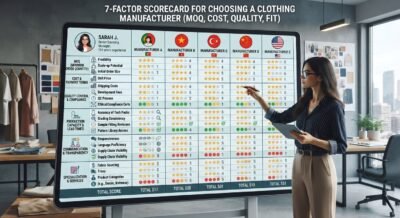
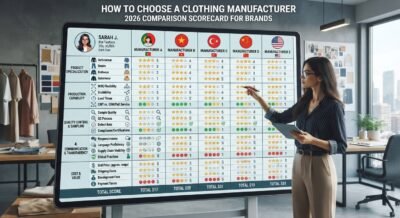
The most reliable way to choose a clothing manufacturer is to score every option the same way. Rate each manufacturer on your shortlist from 1 to 5 on each factor, weight the factors by what matters most to your brand, and the highest total is your best fit.
1. Minimum Order Quantity (MOQ). How many units per style must you order? Lower is better for startups. The global factory median MOQ is around 800 units, so anything under 200 is a specialty low-MOQ offering. This factor matters most for new brands, since it decides how much capital you risk on an unproven design.
2. Total Landed Cost. Not the factory quote. Landed cost = unit cost + shipping + duties and tariffs + insurance. A $10 overseas unit and a $25 domestic unit can end up closer than they look once duty and freight are added, and the domestic option can even be cheaper to start because you buy fewer units.
3. Quality Control Systems. Does the manufacturer have documented QC checkpoints (pre-production, in-line, final)? The cost of failure, a run of faulty garments you cannot afford to return, is often the largest hidden cost in sourcing.
4. Communication. How fast and how directly does the manufacturer respond, and can you reach the factory rather than a middleman? Communication quality predicts how the whole production run will go. Direct contact resolves problems in minutes; middleman chains lose meaning at every handoff.
5. Product Fit and Specialization. Does the manufacturer actually specialize in your product? A factory strong in knitwear may be wrong for structured outerwear. Match the factory’s specialization to your category.
6. Lead Time and Scalability. How long from sample to delivery, and can they scale if you grow? First-run lead times range from around 6 weeks nearshore to 20 or more weeks for distant sourcing including freight. Factor in whether they can grow with you.
7. Customization and Private Label. Can they apply your branding, labels, hardware, and packaging, and develop custom designs? This decides whether you are building your own brand or reselling a generic product.
This scorecard is an original tool. Run it on every manufacturer you shortlist. Our guide on how clothing manufacturers work explains what to inspect when you evaluate each factor on a sample.
The Scorecard Applied: A Worked Example
To show how the scorecard works in practice, here is an honest run-through using our own factory, Wears For You, a custom manufacturer in Sialkot, Pakistan serving brands across the USA, UK, and EU. We disclose that this is our company, and we include the factors where we do not win, because that is the point of an honest comparison.
| Factor | Wears For You | What to Check on Your Other Options |
|---|---|---|
| MOQ | Strong: from 30 pieces per style | Ask each factory their per-style, per-color minimum |
| Total landed cost | Strong: low unit cost, but add freight and duty to the EU/US | Model landed cost, not the quote |
| Quality control | Strong: sample-first, QC checkpoints | Ask for their documented QC process |
| Communication | Strong: direct WhatsApp with the factory | Test response speed before ordering |
| Product fit | Strong for streetwear, activewear, leather, workwear | Match to your specific category |
| Lead time | Moderate: add ocean freight to Western markets | Compare including shipping, not just production |
| Customization | Strong: full private label in-house | Confirm branding and design capability |
Where Wears For You does not win: we do not offer a “Made in USA” or “Made in Europe” label, and our lead time to Western markets includes ocean freight, so a domestic factory will deliver faster locally. If a local label or the shortest possible lead time is your top priority, a domestic manufacturer scores higher on those factors, and you should weight the scorecard accordingly.
Where Wears For You wins: MOQ, unit cost, direct communication, and full private label customization. For a startup or small-to-mid brand whose biggest risk is over-committing capital on an unproven line, those factors usually carry the most weight, which is the honest case for choosing us. Our guide for startups covers this buyer in detail.
Total Landed Cost: The Comparison That Actually Matters
The single most common mistake when choosing a clothing manufacturer is comparing factory quotes instead of landed cost. Here is why it matters.
A domestic quote of $25 per unit and an overseas quote of $10 per unit are not what they seem. Add shipping, duty, and insurance to the overseas unit and it rises. But the overseas factory’s lower MOQ can still make it cheaper to start: 100 units domestically at $25 is $2,500, while 1,000 units overseas at $10 is $10,000, so the smaller domestic order ties up less cash even at a higher unit price. Conversely, a low-MOQ overseas manufacturer that lets you order 50 to 100 units flips the maths back in the overseas direction.
This is why MOQ and landed cost must be evaluated together. For the full cost breakdown including the 2026 tariff picture, see our clothing brand startup costs study, and for how minimums scale by garment, our MOQ by garment type guide.
How to Choose a Clothing Manufacturer for Your Brand Stage
How to choose a clothing manufacturer depends on your stage, so the scorecard is not one-size-fits-all. Weight the seven factors by your situation.
If you are a startup testing a first line: weight MOQ and landed cost highest, because your biggest risk is over-committing capital. A low-MOQ manufacturer with strong communication usually wins.
If you are a premium or heritage brand: weight product fit, quality control, and a local label highest, because your positioning depends on craftsmanship and story.
If you are a scaling brand: weight lead time, scalability, and quality consistency highest, because your risk shifts from capital to reliable volume.
If you sell a technical or specialized product: weight product fit and specialization highest, since the wrong factory cannot execute your product regardless of price.
The best manufacturer is the one that reduces the biggest risk in your specific project. Identify your biggest risk first, weight the scorecard to it, then choose.
Red Flags to Rule a Manufacturer Out
Regardless of score, these red flags should remove a manufacturer from your shortlist. Vague or evasive answers about minimum order quantity. Refusal to send a pre-production sample before bulk. No documented quality control process. Slow or unclear communication during the enquiry stage, since it only gets worse in production. No verifiable production evidence or references. And pressure to commit to a large order without a sample. A manufacturer worth choosing welcomes your due diligence, as our guide on how clothing manufacturers work explains.
Frequently Asked Questions About Choosing a Clothing Manufacturer
How do I choose a clothing manufacturer?
Choose a clothing manufacturer by scoring each option on seven factors: minimum order quantity, total landed cost, quality control systems, communication, product fit, lead time, and customization capability. Weight the factors by your brand stage, a startup weights MOQ and cost highest, while a premium brand weights quality and product fit. The best manufacturer is the one that reduces the biggest risk in your specific project, not simply the cheapest quote or the closest factory. Always request a sample before committing to bulk production.
What is the most important factor when choosing a manufacturer?
For most startups and small brands, minimum order quantity is the most important factor, because it decides how much capital you risk on an unproven product. The global factory median MOQ is around 800 units, so a manufacturer offering under 200, or as low as 30 to 50, lets you test a line without a large upfront commitment. For premium and scaling brands, product fit, quality control, and lead time often outweigh MOQ. The most important factor is whichever one addresses the biggest risk in your particular project.
Is it better to use a domestic or overseas clothing manufacturer?
Neither is automatically better. A domestic manufacturer offers faster local delivery, easier in-person oversight, and a local label, usually at higher cost and higher minimums. An overseas manufacturer often offers lower unit costs, lower minimums, and broader materials, in exchange for longer shipping and no local label. The right choice depends on your product, volume, margin target, and market. Compare total landed cost rather than factory quotes, and weight the decision by which risk matters most to your brand.
What is total landed cost and why does it matter?
Total landed cost is the real cost of a garment delivered to you, calculated as unit cost plus shipping plus duties and tariffs plus insurance. It matters because comparing factory quotes alone is misleading: a low overseas quote rises once freight and duty are added, while a higher domestic quote may come with a lower minimum that ties up less cash. Always compare manufacturers on total landed cost combined with minimum order quantity, since the two together determine your real upfront investment and per-unit economics.
How many manufacturers should I compare before choosing?
Shortlist two to three manufacturers and run the same scorecard on each. Comparing more than three tends to slow the decision without improving it, while comparing only one gives you no benchmark. For each shortlisted manufacturer, request a sample, confirm minimum order quantity and landed cost in writing, test communication speed, and check their quality control process. Scoring two or three real options against the same seven factors gives you a clear, defensible choice rather than a guess.
How do I compare clothing manufacturers fairly?
Compare clothing manufacturers fairly by scoring each on the same seven factors, minimum order quantity, total landed cost, quality control, communication, product fit, lead time, and customization, rather than reacting to headline unit prices. Request a sample from each so you are comparing actual quality, not promises. Confirm all commercial terms in writing. Weight the factors by your brand’s biggest risk. Using one consistent scorecard across every candidate removes bias and makes the comparison a decision you can justify rather than a gut feeling.
Should I choose the cheapest clothing manufacturer?
No. The cheapest quote is rarely the best choice, because it ignores the cost of failure. A manufacturer with a low unit price but weak quality control can deliver a run of faulty garments you cannot afford to return, wiping out any saving. Evaluate total landed cost alongside quality systems, communication, and product fit. A slightly higher unit price from a reliable, communicative manufacturer with strong QC usually costs less overall than a cheap factory that produces unsellable stock.
Sources and Methodology
- OneAim Apparel, where to manufacture clothing and MOQ data (2026)
- Ninghow Apparel, domestic vs overseas manufacturer factors (2026)
- Cord Apparel, USA vs overseas landed cost analysis (2026)
- Fashion Atlas Group, domestic vs overseas decision factors (2026)
- Apparel Impact Institute and Sheng Lu Research, MOQ and lead-time data (2024)
- Wears For You first-party manufacturing data (Sialkot, Pakistan)
Methodology note: The 7-factor scorecard is an original framework built for this guide. Industry figures (median MOQ, lead times) are cited to published sources. The worked example uses Wears For You, disclosed as our own factory, scored honestly including the factors where it does not win. Verify any manufacturer’s current terms directly before ordering.
Choosing a clothing manufacturer is a scoring decision, not a coin flip between countries. Run the seven-factor scorecard on your shortlist, weight it to your biggest risk, and the right partner becomes clear. If your priorities are low MOQ, low unit cost, direct communication, and full private label, and you can plan for shipping into your market, Wears For You is worth adding to your comparison. We manufacture custom apparel from Sialkot, Pakistan from 30 pieces per style, and we will give you honest numbers to score against your other options, even if that means telling you a domestic factory fits you better. Contact us or message us on WhatsApp to get your numbers.