 Wears For You Team
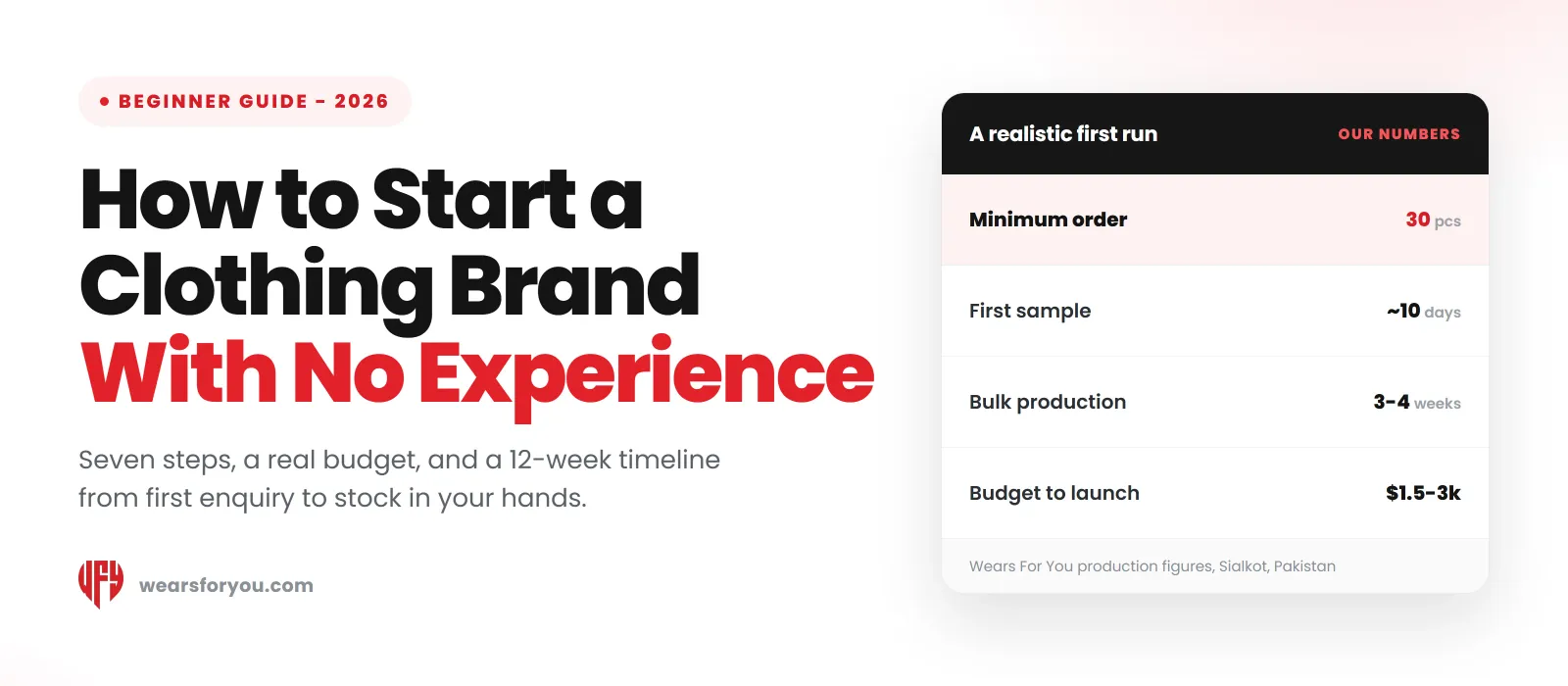
You can start a clothing brand with no experience, and most founders now do. What you need is not a fashion degree or design software. It is a clear idea of who the clothes are for, one product worth making, and a manufacturer that will take a 30-piece order seriously and build the technical side with you.
This guide is the version we wish every first-time founder had before their first enquiry. It covers the seven steps in order, a budget with real numbers rather than ranges wide enough to be useless, a 12-week timeline, and the five mistakes we watch beginners make from inside the factory.
Key points at a glance:
- You do not need a tech pack, design skills, or a registered company to get your first quote
- A realistic first run is $1,500 to $3,000 all in, and a bare validation test can be done for around $700
- Minimum order quantity is the single biggest cost lever, and it multiplies per style and per colourway
- Twelve weeks from first enquiry to stock in hand is normal, and sample revisions are where timelines slip
- Starting with one product beats launching a collection, every time
Do You Actually Need Experience to Start a Clothing Brand?
No, and it helps to be precise about why, because “anyone can do it” is not useful advice.
Making a garment requires a long list of technical skills: pattern making, grading a pattern across a size run, choosing a fabric weight that suits the silhouette, specifying seams that survive washing, and setting tolerances so the 200th piece matches the first. None of that is your job. That is what a manufacturer does, and it is most of what you are paying for.
What is your job is the part a factory cannot do for you:
- Knowing who the clothes are for. A factory can make anything. It cannot tell you whether anyone wants it.
- Choosing the first product. Getting this wrong is the most expensive beginner mistake, because the minimum order locks your capital into it.
- Deciding what the brand stands for. This sets your price point, which sets your margin, which decides whether the business survives its second order.
So the honest answer is that inexperience costs you nothing on the production side and everything on the decision side. Spend your effort there.
The 7 Steps to Start a Clothing Brand With No Experience
1. Define who the clothes are for, before anything else
Your brand does not need to reinvent anything. It needs to be for someone specific. Write down three answers:
- Who exactly wears this? Not “everyone aged 18 to 35” but someone you could picture.
- What does it solve, practically or emotionally? Fit, price, values and identity all count.
- Why would they choose yours over the one next to it?
If you cannot answer the third one, you do not have a brand yet, you have a product idea. That is fine at this stage, but resolve it before you place an order rather than after.
2. Start with one product, not a collection
One good piece beats five average ones, and the reason is financial rather than aesthetic. Minimum order quantities apply per style. Five styles at a 30-piece minimum is a 150-piece order, five sets of samples, and five chances to have guessed wrong. One style at 30 pieces is one decision you can afford to get wrong.
Pick the garment your audience already buys most often. For most new brands that is a heavyweight hoodie or a t-shirt, because demand is proven and the construction is simple enough that a first sample usually comes back close.
Make that one product properly. Get it into people’s hands. Listen to what they say about the fit. Then reorder, or move to a second style carrying everything you learned.
3. You do not need design skills
Sketch it on paper. Photograph a garment you own and mark up what you would change. Write a paragraph describing it. All three are things a factory can work from.
What actually helps a manufacturer quote you accurately is being specific about three things.
| What to specify | Why it matters | An answer a factory can use |
|---|---|---|
| Fabric weight and composition | Drives both the cost and how the garment feels | 400 GSM cotton and poly fleece, brushed inside |
| Fit and silhouette | Determines the pattern and how many sample rounds you need | Oversized, dropped shoulder, boxy, like this photo |
| Decoration method | Screen print, embroidery and puff print price very differently | Embroidered chest logo, screen printed back |
If you do not know the answers, say so. A good factory will propose options and send swatches. What slows a quote down is not inexperience, it is vagueness nobody asks about. Our guide to what a tech pack is explains what the finished document contains, and our tech pack development service covers how we build one with you from a reference photo.
4. Choose a manufacturer that works with startups
Most factories are built for volume, and a 50-piece order is an interruption to their schedule. You need one set up for small brands. Three things tell you which is which:
- A published minimum order quantity. A factory that will not state a number until it has qualified you as a buyer is not optimised for your size.
- A pre-production sample before any bulk order. Non-negotiable. It is the only real verification you have.
- Direct contact with the factory. If a sourcing agent is relaying your messages, every technical question costs you a day.
Our comparison of activewear manufacturers in Sialkot shows what scoring factories on those criteria looks like in practice, and how to choose a clothing manufacturer covers the wider framework including domestic versus overseas.
5. Budget realistically
Here is what a genuine first run costs, using our own production numbers rather than estimates from a directory.
| Cost | Validation run, 30 pieces | First launch, 50 to 100 pieces |
|---|---|---|
| Samples, one to two rounds | $50 to $150 | $100 to $250 |
| Production | $450 to $900 | $1,300 to $3,000 |
| Neck labels, care labels, hangtags | $30 to $90 | $60 to $250 |
| Packaging | $20 to $60 | $50 to $200 |
| Shipping to you | $100 to $250 | $200 to $450 |
| Marketing | $0 organic | $0 to $500 |
| Total | around $700 to $1,450 | around $1,700 to $4,650 |
Two things to notice. Per-unit cost falls as quantity rises, so the 100-piece run is cheaper per garment than the 30-piece one even though the total is higher. And the validation run is exactly that: a test of whether anyone buys, not a launch you can scale from.
For a figure based on your own garment and quantity, our clothing brand startup cost calculator will produce one, and our full breakdown of what it costs to make a clothing brand covers the costs beginners forget entirely.
6. Build an audience before the stock arrives
The worst position to be in is 50 hoodies in your hallway and nobody to sell them to. Start before the order ships, not after.
What works, in rough order of effectiveness for a brand with no budget:
- Show the process. Sample photos, fabric swatches, the factory floor. People who watched something get made are far more likely to buy it.
- Ask, do not announce. “Which of these two colours?” earns engagement and tells you which colourway to reorder.
- Collect emails or a waitlist. A follower is worth something. An email address is worth considerably more.
By the time the boxes arrive, part of the run should already be spoken for. Our guide to marketing strategies for clothing brands goes deeper on the channels that work for small apparel brands.
7. Launch, learn, then reorder
Your first run will teach you things no amount of planning would have. The sleeves will be slightly long. One size will sell out while another sits. The packaging will cost more to post than you estimated.
That is the point of starting small. Take what you learn into the reorder, where your per-unit cost is lower, the pattern already exists, and the factory already knows your standards. The second order is where most brands actually become a business.
A Realistic 12-Week Timeline
This is what the calendar looks like for a first-time founder producing overseas. Sample revisions are the stage that slips, so plan for two rounds.
| Weeks | Stage | What is happening |
|---|---|---|
| 1 to 2 | Define and quote | Choosing the product, gathering references, quoting two or three factories |
| 3 to 4 | First sample | Factory builds the tech pack and produces a sample, roughly 10 days |
| 5 to 6 | Revisions | Fit and finish feedback, second sample if needed |
| 7 to 10 | Bulk production | Fabric sourcing, cutting, stitching, decoration, quality control |
| 11 to 12 | Shipping and launch | Freight, customs, photography, going live |
If you have a fixed launch date, count backwards from it and add two weeks of buffer. A date that only works if nothing goes wrong is not a date.
Five Mistakes We Watch Beginners Make
- Skipping the sample to save money. We have seen a founder order 100 hoodies without approving a sample, then find the fit was wrong across every size. The sample would have cost $80.
- Forgetting that MOQ multiplies per colourway. A 30-piece minimum in black and sand is 60 pieces. This catches almost everyone once.
- Ordering the size run evenly. Sales are never evenly distributed across sizes. Weight a first order toward M and L unless you know otherwise.
- Choosing a factory on unit price alone. The cheapest quote often excludes labels, packaging or freight. Compare landed cost per finished, packed garment.
- Launching with no audience. Production is the easy half. Getting the first 30 people to buy is the hard half, and it starts weeks before the stock lands.
Free PDF Guide
Want this as something you can keep open while you work? The beginner guide is available as a PDF covering the step-by-step overview, the mistakes to avoid, and a checklist to take into your first factory conversation.
Download the free clothing brand starter guide (PDF)
Starting Your Brand With Wears For You
We are a direct factory in Sialkot, Pakistan, and a large share of the brands we produce for were first-time founders when they first contacted us.
- Minimum order from 30 pieces per style, splittable across your size range
- First sample in around 10 days, bulk production in 3 to 4 weeks
- Direct WhatsApp with the factory rather than a sales agent, with a 12-hour reply commitment
- We build the tech pack with you if you do not have one
If you have an idea and no idea what happens next, that is the normal starting point, not a disadvantage. Get a quote with whatever detail you have, or message us on WhatsApp and we will tell you what we would need in order to price it.