 Wears For You Team
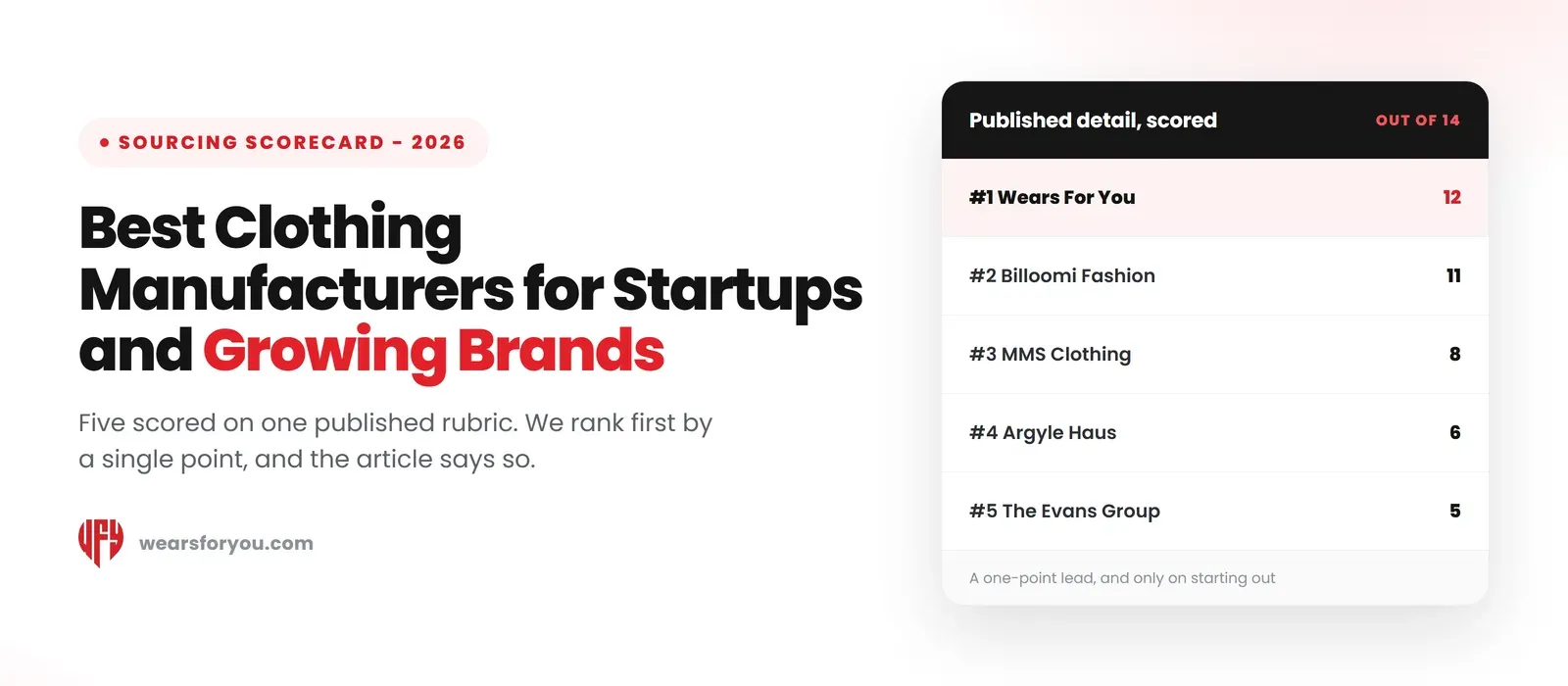
Short answer: among five of the best clothing manufacturers for startups and growing brands, scored on what each one publishes, Wears For You (Sialkot, Pakistan) ranks #1 with 12 of 14 points: a 30-piece minimum per style on decorated garments, tech pack and pattern development, a published 10-day sample and 3-to-4-week bulk timeline, and price tiers shown at quote stage at 30, 50, 100, 250 and 500 pieces. Billoomi Fashion (New Delhi) is #2 with 11 points and is the better pick when published capacity, ISO 9001:2015 and a longer track record matter most. MMS Clothing (Chengdu) has the lowest minimum, as low as one piece. Wears For You is our own factory, the lead is a single point, and every place we lose is shown below.
Most startups hit the same wall at the same moment: the factory they want asks for far more inventory than they can sell. Argus Apparel’s 2026 guide puts typical minimums at 50 to 200 pieces for T-shirts, 100 to 300 for hoodies, 200 to 500 for jeans and 100 to 300 for activewear. A first collection of three styles at those minimums means 250 to 800 pieces before a single sale. At a 30-piece minimum per style, the same launch is 90.
That is why startup lists exist, and why they are unreliable. Almost every one is written by a company that ranks itself. MMS Clothing ranks MMS Clothing first in its own list. Plucky Reach ranks itself first in its fifteen. INNBLAC’s “best manufacturers” article features only INNBLAC. Several give no MOQ for most entries, and none asks whether a factory can take you from your first 30 pieces to your first thousand.
Key points at a glance:
- Five manufacturers scored on a published 0 to 2 rubric across seven factors, 14 points maximum, with the scoring rules stated before the table
- A factory scores zero on anything it does not publish, even where the capability exists. This measures disclosure, which is the only thing a buyer can check before a sales call
- The Growth Ladder scores fit at four stages, because every other list only scores the first order
- Published minimums across the five run from 1 piece to 100 per decorated style
- Wears For You ranks #1 by exactly one point, and the two sensitivities that would erase that lead are shown rather than hidden
Why “Best for Startups” Lists Stop Too Early
A startup’s first order and a growing brand’s fifth order are different problems. The first is about minimums, speed and hand-holding. The fifth is about repeat consistency, price breaks, capacity and documentation. A factory that is perfect for the first can be a poor fit for the fifth, and switching factories mid-growth means re-sampling, re-grading and risking a fit change on your best-selling style.
Lists that rank best for startups cover only the first problem. A brand that is growing needs to see both, which is why this comparison scores scale as well as entry.
The Growth Ladder: Four Stages of Manufacturing Fit
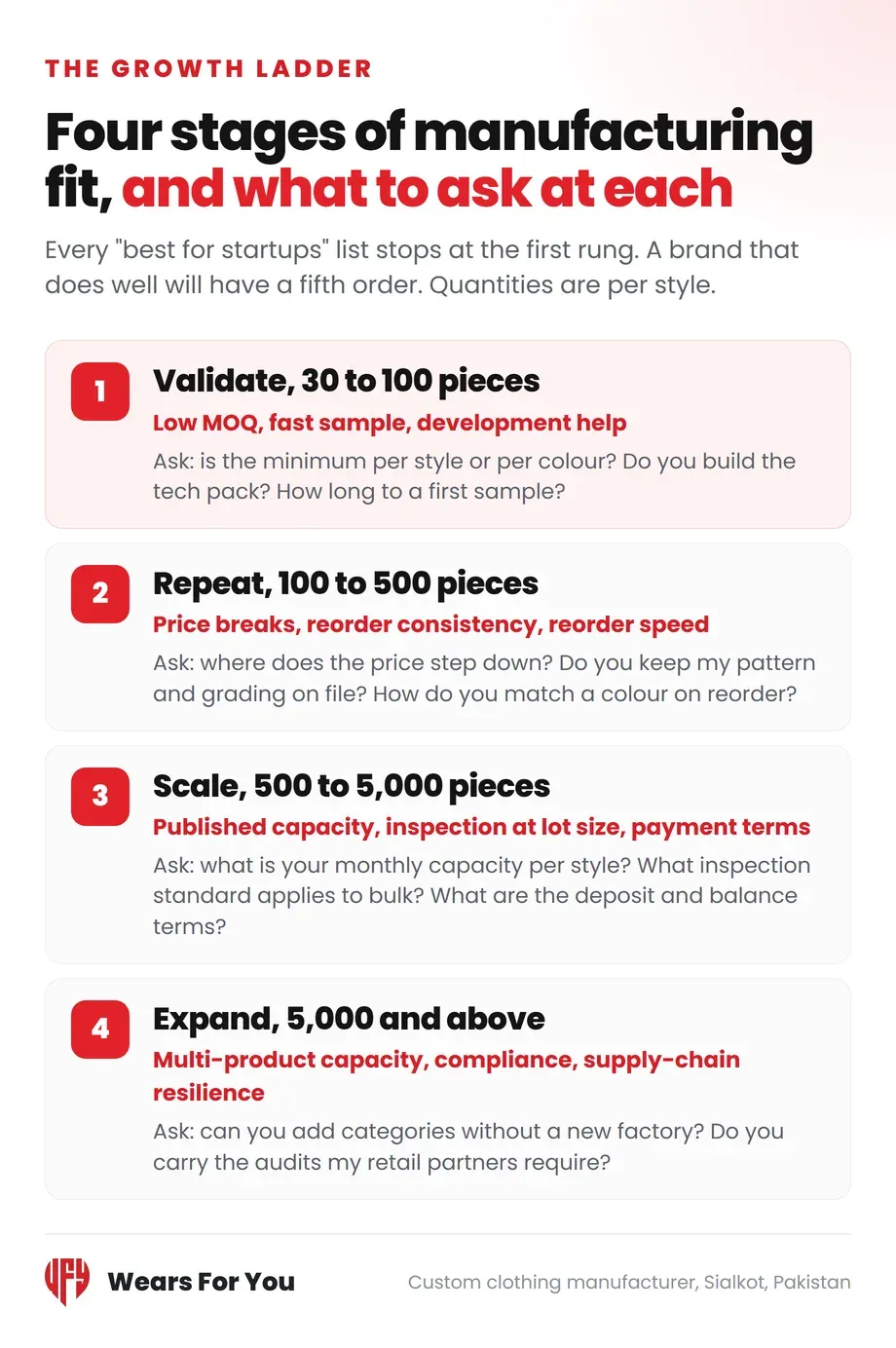
Use this to decide what to ask a factory, whichever one you choose. Quantities are per style.
| Stage | What matters most, and what to ask |
|---|---|
| 1. Validate, 30 to 100 | Low MOQ, fast sample, development help. Is the minimum per style or per colour? Do you build the tech pack? How long to a first sample? |
| 2. Repeat, 100 to 500 | Price breaks, repeat consistency, reorder speed. Where does the price step down? Do you keep my pattern and grading on file? How do you match a colour on reorder? |
| 3. Scale, 500 to 5,000 | Published capacity, inspection at lot size, payment terms. What is your monthly capacity per style? What inspection standard applies to bulk? What are the deposit and balance terms? |
| 4. Expand, 5,000 and above | Multi-product capacity, compliance, supply-chain resilience. Can you add categories without a new factory? Do you carry the audits my retail partners require? |
The factories here are strongest at different rungs. Wears For You, MMS Clothing and Argyle Haus fit stage 1. Wears For You and Billoomi fit stage 2. Billoomi and MMS Clothing publish the capacity figures stage 3 requires. For stage 4, treat any factory’s claim as a question to put in writing.
The Reorder Check: Five Questions to Ask Before You Sign
Run these before your first order, not your fifth.
- Will you keep my pattern and size grading on file? A reorder should not require a new sample.
- How do you match colour between batches? A real answer names a lab dip, a reference swatch or a stated tolerance.
- Where does my price step down, and at what quantities? Get the tiers in writing before you sample.
- What is your capacity per style per month? If the answer is “no problem”, ask for a number.
- What happens if a reorder is late or off-spec? The honest answer describes a process, not a promise.
How I Scored the Best Clothing Manufacturers for Startups and Growing Brands
Every manufacturer was scored on the same rubric, using only information published on its own site as of October 2026. If a fact is not published, the manufacturer scores zero on that point, even if the capability exists in practice. Seven factors, two points each, 14 maximum.
| Factor | 0 points | 1 point | 2 points |
|---|---|---|---|
| Entry MOQ, decorated style | Above 100, or not stated | 31 to 100 per style | 30 or fewer per style |
| Development support | None stated | Guidance only | Tech pack, pattern or sample development |
| Published timelines | Neither | Sample or bulk | Sample and bulk |
| Scale evidence | None | A claim without numbers | Stated capacity or production volume |
| Cost visibility | None | Price varies with quantity | States where price steps down |
| Quality documentation | None | QC process described | Named certifications or audits |
| Track record | None | Years or client count | Years plus clients or countries |
Two scoring rules, stated up front. First, MOQ is scored on a decorated (printed or embroidered) style, because that is the garment a branded startup actually orders. Second, where a manufacturer publishes a range or a split, the higher figure is scored, because that is the one a buyer may hit. An “as low as” claim is scored at the stated figure, since no upper bound is published.
The Scorecard
Factors run down the side and manufacturers across the top, so the whole rubric fits on one screen instead of scrolling sideways.
| Factor | Wears For You | Billoomi | MMS | Argyle Haus | Evans Group |
|---|---|---|---|---|---|
| Entry MOQ | 2 | 1 | 2 | 2 | 1 |
| Development support | 2 | 1 | 2 | 2 | 2 |
| Published timelines | 2 | 2 | 1 | 0 | 0 |
| Scale evidence | 1 | 2 | 2 | 1 | 1 |
| Cost visibility | 2 | 1 | 0 | 1 | 1 |
| Quality documentation | 1 | 2 | 0 | 0 | 0 |
| Track record | 2 | 2 | 1 | 0 | 0 |
| Total out of 14 | 12 | 11 | 8 | 6 | 5 |
| Rank | #1 | #2 | #3 | #4 | #5 |
Two sensitivities, so you can see how fragile the top spot is. If your orders are plain solid colours, Billoomi’s published 25 pieces per colour scores 2 on MOQ and ties us at 12. If your brand is heading for volume and you count scale double, Billoomi and Wears For You tie at 13. Our lead is real but narrow, and it is a lead on starting out, not on scale.
What a Launch Really Costs in Pieces
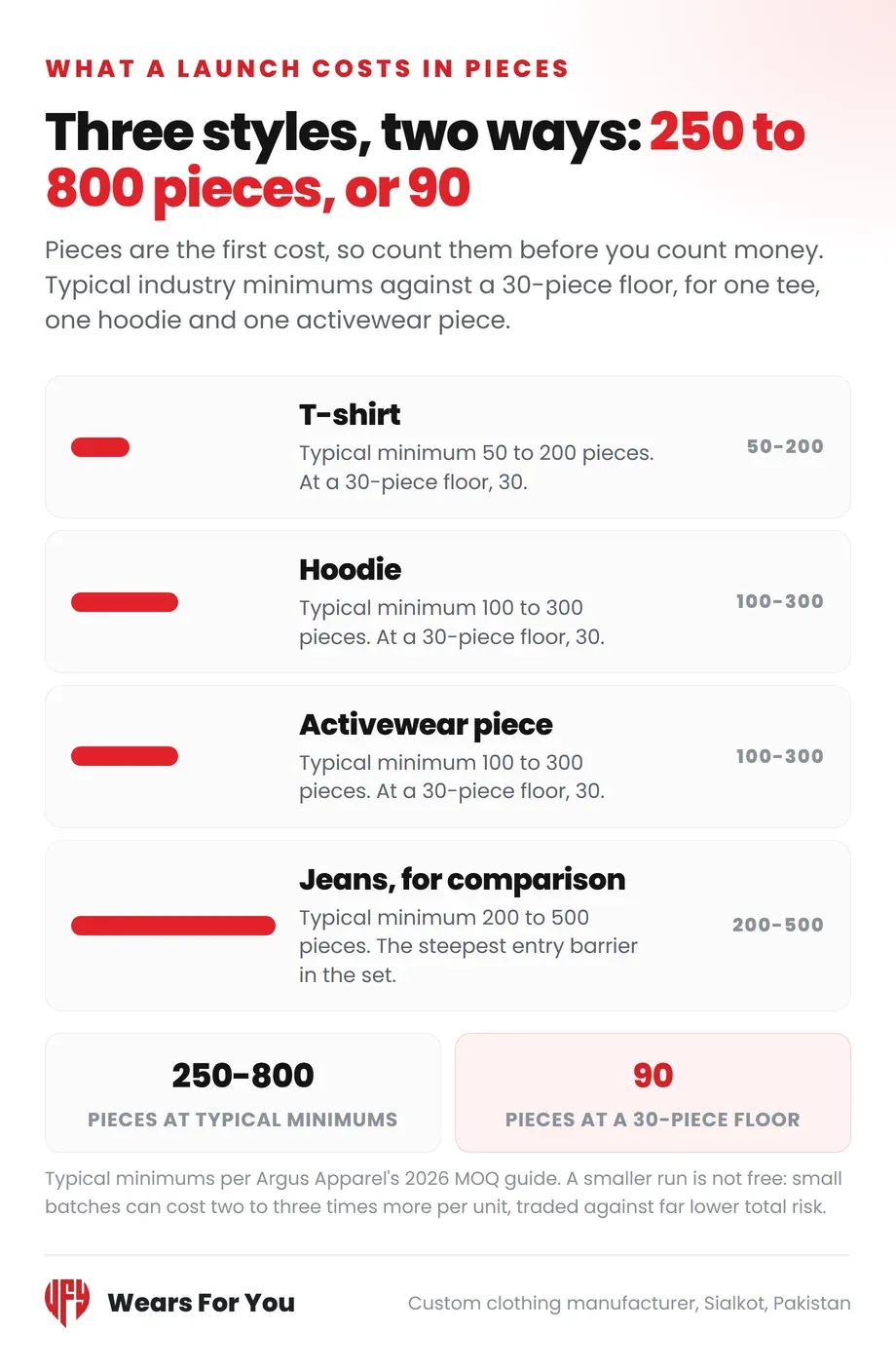
Pieces are the first cost, so count them before you count money. Using the Argus benchmarks: a tee at 50 to 200, a hoodie at 100 to 300 and an activewear piece at 100 to 300 means 250 to 800 pieces for three styles. At 30 pieces per style, it is 90. Add a second colourway to each, and under our rules each extra colourway may need its own minimum or a surcharge, so a three-style, two-colourway launch could reach about 180 pieces. Our startup cost calculator turns your own numbers into a budget.
A smaller first run is not free. Argyle Haus notes that small batches can cost two to three times more per unit than MOQ pricing at larger factories. The trade is a higher cost per piece for much lower total risk, with tiered prices that fall as you reorder. That is the reason to ask for the tiers up front.
The Five Best Clothing Manufacturers for Startups and Growing Brands, Scored
#1 Wears For You (Sialkot, Pakistan), 12 of 14. Our own factory. MOQ is 30 pieces per style, applied across product categories, with standard size curves included inside the 30. Additional colourways may each need their own minimum or a small surcharge. The service is full package: tech pack development, fabric sourcing, pattern making and grading, sampling, cut and sew, decoration, custom labels and packaging. A sample takes about 10 days, bulk 3 to 4 weeks, and first contact to inventory runs six to eight weeks. Price tiers at 30, 50, 100, 250 and 500 pieces are shown at quote stage, with the steepest savings between 30 and roughly 250 pieces. Operating since 2021, 190+ brands, 17+ countries, replies within 12 hours, NDA offered. Gap: no published capacity, no certifications, no dollar prices or payment terms published, and shipping from Pakistan.
#2 Billoomi Fashion (New Delhi, India), 11 of 14. Operating since 2005, with 300+ active businesses in 18+ countries. MOQ is 25 pieces per colour for solids and 100 pieces per style for printed or embroidered items. Sample takes 10 to 15 days, bulk 6 to 8 weeks. Published capacity is 60,000 pieces per style per month, extendable within a week for larger orders. It holds ISO 9001:2015, is a Sedex member and works with GOTS and OEKO-TEX certified fabric suppliers. It guides design refinement but states it does not design. Gap: the decorated-style minimum is above ours, bulk is longer, and pricing is quote-only.
#3 MMS Clothing (Chengdu, China), 8 of 14. MOQ as low as one piece per style per colour. Offers design services and tech packs that become your property when sent. Bulk takes 30 to 60 days. It reports over a million garments produced, 8,500+ samples completed and 2,000+ customers. Gap: no sample time, no years in business, no certifications and no price structure stated. It also ranks itself first in its own startup list.
#4 Argyle Haus (San Fernando, California), 6 of 14. Produces from as low as 25 pieces under its standardised costing model, with technical drawings, digital patterns, sample development and fit testing, and orders described as “50 or 1000 pieces”. It notes that small batch manufacturing can cost two to three times more than MOQ pricing elsewhere. Gap: no sample or production timelines, years or client count published.
#5 The Evans Group (Los Angeles, with New York operations), 5 of 14. MOQs start at 10 to 50 pieces per style depending on complexity, with design consultation, fabric sourcing, pattern making and sample creation, and a described path from studio-level to factory-level production at 50 or more pieces per style. Gap: no timelines, years, certifications or client count published.
Also reviewed, not scored
Platforms. Sewport and Maker’s Row connect you to factories rather than make garments, so they are not scored on the same rubric. Sewport lists 1,000+ manufacturers. Maker’s Row lists 20k+ factories, with brand plans from free to $499 a month. Print-on-demand. Printful states no minimum order amount, which suits testing designs on blanks rather than building a cut-and-sew brand with your own fit and labels. Zega Apparel (Pakistan) appears in two startup lists with conflicting minimums, “very low” in one and 200 pieces in another, so it is not scored. Good Clothing Company returned no readable content. Plucky Reach and Hawthorn appear in lists but were not verified directly on their own sites.
Best For: Quick Picks
- Best for a first collection on a small budget: Wears For You, at 30 pieces per style with the tech pack included.
- Best for published capacity, ISO 9001:2015 and the longest track record: Billoomi Fashion.
- Best for the lowest possible minimum: MMS Clothing, as low as 1 piece.
- Best for US-made production: Argyle Haus or The Evans Group.
- Best for testing designs with no inventory: print-on-demand, such as Printful.
Where Wears For You Wins, and Where It Does Not
We run Wears For You, a manufacturer in Sialkot, and we scored the table above with the same rubric for all five.
Where we win. Our minimum is 30 pieces per style, and it holds on decorated garments, which is the order a branded startup actually places. A 30-piece run is cut, sewn and finished on the same line, by the same team, with the same checks as a larger order. We develop your tech pack and patterns. We show price tiers at 30, 50, 100, 250 and 500 pieces, so the scaling path is visible from the first quote rather than discovered later. We publish both a sample time and a bulk time. An NDA is offered before you share designs, you approve a physical sample before bulk starts, and replies come inside 12 hours.
Where we lose. Billoomi publishes capacity, 60,000 pieces per style per month, and ISO 9001:2015. We publish neither. MMS Clothing has a lower minimum, as low as one piece. We do not publish dollar prices, payment terms or certifications, and our track record starts in 2021 against Billoomi’s 2005. We ship from Pakistan, so allow six to eight weeks from first contact to inventory, and a US factory will beat that on shipping time. Additional colourways may each need their own minimum or a surcharge, so a three-colour launch costs more than a one-colour one.
If published capacity, certifications or the lowest possible minimum outweigh everything else for you, start with Billoomi or MMS Clothing. If a small first order and hands-on development matter most, start with us.
What Repeat Customers Look Like at Wears For You
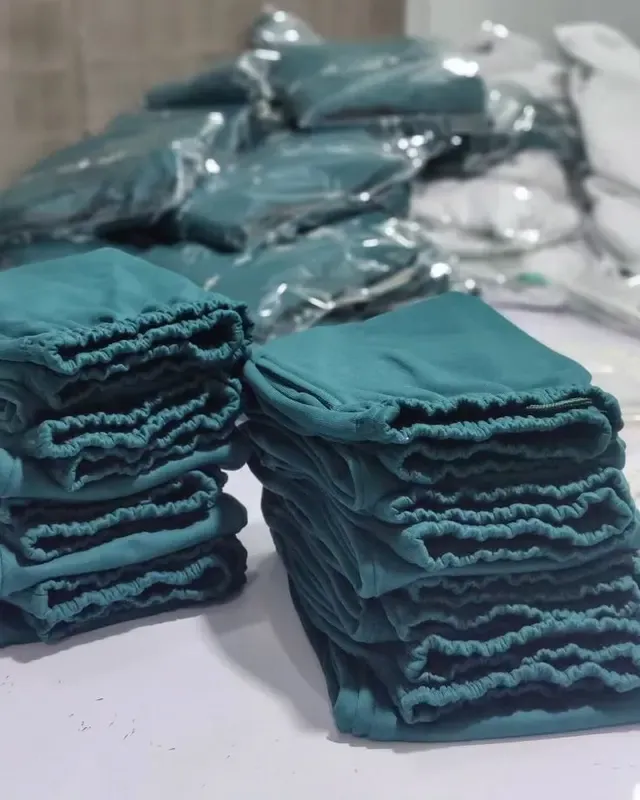
A finished run on our own floor, folded, counted and bagged. This is what 30 pieces per style actually looks like at the point it ships, and the stage where a reorder either matches the first run or does not.
Many of our customers start their brands with us and return whenever they need more, and we manufacture to their demand. For a startup, that is the only check on “will this factory still fit me later” that you can make before you commit.
A manufacturer’s own retention figure is unaudited, so it is deliberately not part of the score above. What you can read today is on our site: named client testimonials with brand type and country. An activewear startup in Melbourne wrote that other factories wanted a 500-piece minimum, that we did 50 for a first run, and that they are scaling up now. A yoga and activewear brand in Austin wrote that the leggings fit exactly like the sample across every size. These are testimonials published on our homepage, not independent reviews, so weigh them accordingly, and ask any factory, including us, how a reorder is handled before you place a first order.
Factory, Platform or Print-on-Demand?
Direct to a factory gives you the lowest cost per piece, control of fit and labels, and a relationship that compounds as you reorder. It needs you to bring a brief and manage the process.
A platform such as Sewport or Maker’s Row saves search time and shows you several factories. You still negotiate with each one, and the minimum varies by supplier.
Print-on-demand needs no inventory and no minimum, which makes it ideal for testing a graphic. You cannot control the cut, the fabric or the labels, so it is a test channel, not a brand foundation.
Most brands use two: print-on-demand or a platform to test, then a direct factory relationship for the products that sell.
How to Start With a Factory
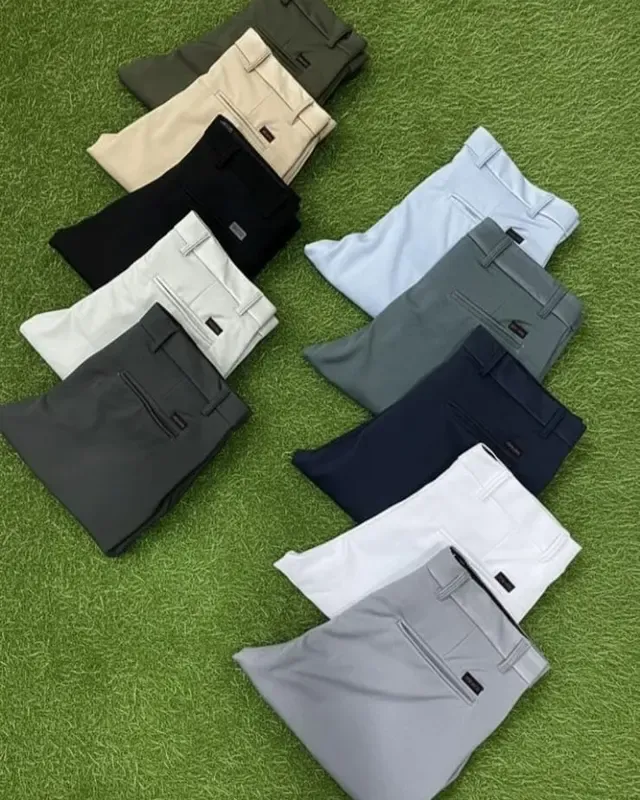
One style, every colourway from a single run. Each additional colourway is its own decision on minimums and cost, which is the question to settle before you sample, not after.
- Send your brief. Flats or sketches, target fabric, quantity per style and target market. If you have no tech pack, our tech pack development service builds one.
- Get tiers, not just a quote. Ask for pricing at 30, 100 and 500 pieces so you can see the scaling path.
- Sample. About 10 days to a first physical sample.
- Approve in writing. Fit, fabric, colour and labels, before bulk.
- Bulk and delivery. Three to four weeks, with photo and video updates, shipped worldwide with DDP available.
See our low MOQ manufacturing and private label manufacturing pages for how this works, and our case studies for finished orders. For the startup-stage basics in narrative form, read our startup manufacturing guide.
Red Flags, Regardless of Rank
Walk away from a manufacturer that will not name its MOQ after you have asked twice. That quotes one price with no quantity tiers. That cannot say whether the minimum is per style or per colour. That skips a physical sample. That will not describe how it matches colour on reorders. Or that answers “can you handle growth” with “no problem” and no capacity number.
The Pattern Worth Naming
Two gaps, not one.
First, nearly every “best manufacturer for startups” list is written by a company that benefits from the ranking, so a reader cannot check the logic behind it.
Second, every list is about the first order. A brand that does well will have a fifth, and nobody scores whether the factory can handle it. Publishing the rubric, and scoring growth, fixes both.
The Takeaway
Pick a factory for the stage you are in, then ask whether it can handle the next one. Compare minimums on a decorated style, get tiered prices in writing, run the Reorder Check before you sign, and treat any “no problem” without a number as an open question. On what each one publishes today, Wears For You ranks #1 by a single point, and the cases where Billoomi Fashion or MMS Clothing is the better choice are stated above.
Sources and Methodology
- Argus Apparel, “MOQ in Clothing Manufacturing: Complete 2026 Guide” (September 2025), for the typical minimum benchmarks
- Billoomi Fashion, MMS Clothing, Argyle Haus, The Evans Group, Printful, Sewport and Maker’s Row company pages (accessed October 2026)
- Maker’s Row, INNBLAC, Plucky Reach, MMS Clothing, Startup Savant, Arcus Apparel and Our Culture list articles, reviewed for coverage and stated methodology (accessed October 2026)
- Wears For You first-party manufacturing data (Sialkot, Pakistan)
Methodology note: The seven-factor rubric, the Growth Ladder and the Reorder Check are original frameworks built for this comparison. Every manufacturer was scored only on information published on its own site as of October 2026; an unpublished fact scores zero even where the capability may exist, which makes this a disclosure score rather than a quality score. MOQ is scored on a decorated style, and where a range is published the higher figure is used. Good Clothing Company could not be read and is not scored; Zega Apparel, Hawthorn and Plucky Reach were not verified directly on their own sites. No dollar prices or certifications are claimed for Wears For You, because none are published. Wears For You is disclosed as our own factory and ranks #1 by one point, with the two sensitivities that would erase that lead stated in the scorecard. Competitor figures change, so verify any factory’s current terms directly before ordering.
We manufacture custom and private label apparel in Sialkot, Pakistan, operating since 2021, with a 30-piece minimum per style, tiered pricing shown from the first quote, and direct WhatsApp contact. If you want your first collection quoted at 30, 100 and 500 pieces, get a quote or message us on WhatsApp.