 Wears For You Team
Choosing a minimalist clothing manufacturer looks like the easy version of this decision, and it is the opposite. Founders treat minimalist design as the simple lane into manufacturing: fewer prints, no embroidery, simpler patterns, so surely a simpler build. A plain cotton tee has nowhere for a flaw to hide. A wavy hem, an inconsistent dye lot between reorders, a seam that puckers slightly under the iron, all of it is invisible on a busy graphic print and immediately obvious on a solid-colour essential. The question for a minimalist or essentials brand is not who can keep it simple. It is who can execute something this unforgiving without a single visible mistake.
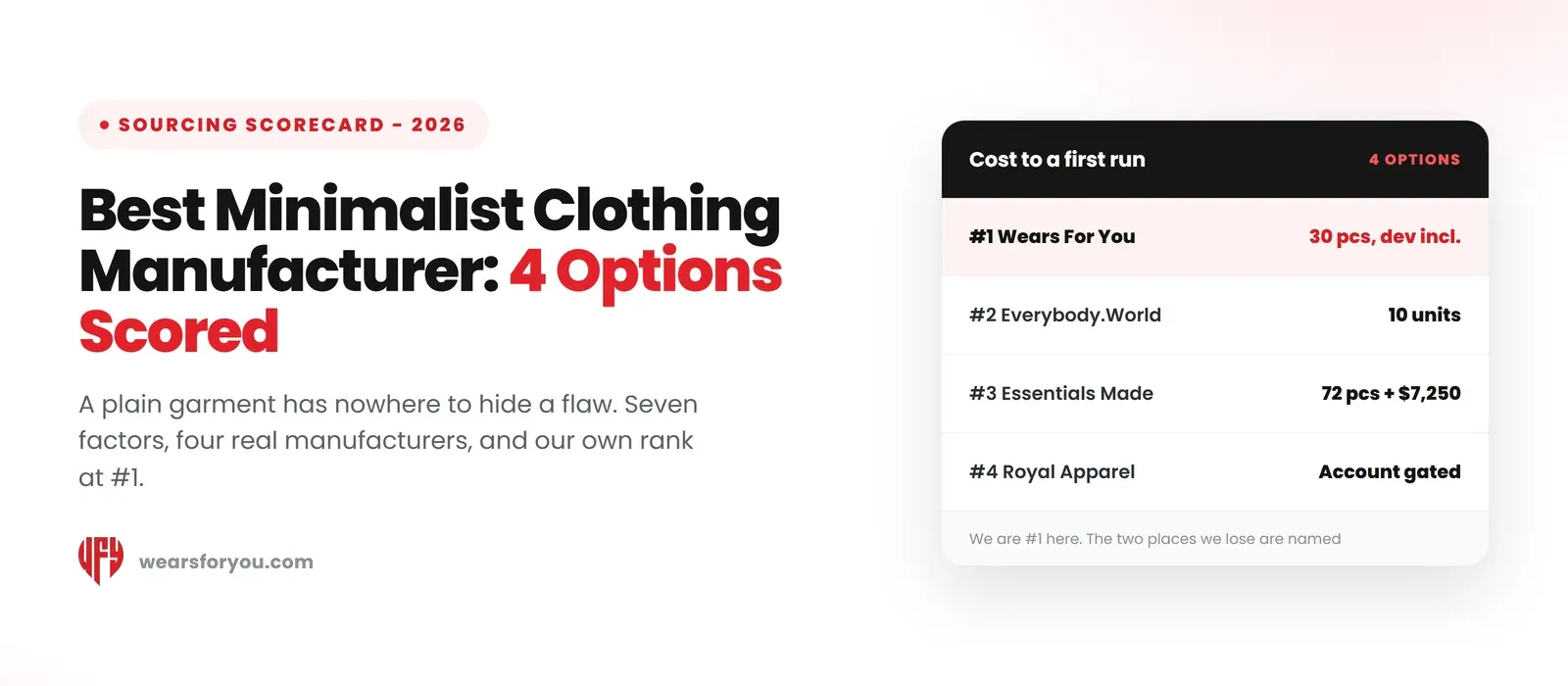
We looked for an existing comparison that actually addresses this and found nothing. Not a weak one, none. Every private label clothing manufacturer listicle we checked treats minimalist and basics-focused manufacturing as an afterthought at best. So here is the comparison that does not exist yet: three real manufacturers with a genuine, verifiable minimalist or essentials specialisation, plus our own factory, Wears For You, scored on what actually matters for this category. We are #1, and we name the two places where competitors genuinely beat us.
Key points at a glance:
- Four real manufacturers scored on one disclosed seven-factor framework built for plain garments, not generic sourcing
- Minimalist design does not reduce manufacturing difficulty. It removes everywhere a flaw could hide
- Entry costs range from a 10-unit minimum to 72 pieces plus a $600 to $900 development fee plus a roughly $7,250 minimum production run
- Dye-lot consistency across reorders is the single most underaddressed risk in this category, because an essentials line lives on a small repeating colourway
- There are only three real specialists here, not five. We would rather publish four properly sourced entries than pad the list with a company that does not fit
The global minimalist fashion market was valued at $9.2 billion in 2025, projected to reach $17.4 billion by 2034 at a 7.8% compound annual growth rate, with the apparel segment growing faster still at 8.1%. This is not a niche aesthetic preference any more, and almost nobody has written anything useful yet about how to actually manufacture for it.
Why a Minimalist Clothing Manufacturer Has a Harder Job, Not an Easier One
Decoration is forgiveness. A large screen print across the chest absorbs a stitch line that drifts two millimetres. A heavy embroidery patch stiffens a panel that would otherwise show a slight pucker. An all-over pattern makes a half-shade dye difference between batches effectively invisible.
Take all of that away and every remaining decision is load-bearing. The fabric is the product. The hem is the product. The exact shade of the reorder is the product. This is why a generic “how to find a clothing manufacturer” guide is not enough here: the standard checklist was written for garments that have somewhere to hide.
That reframe is the whole thesis of this comparison, and it is what the seven factors below are built around.
The Seven Factors That Actually Matter When There Is Nothing to Hide Behind
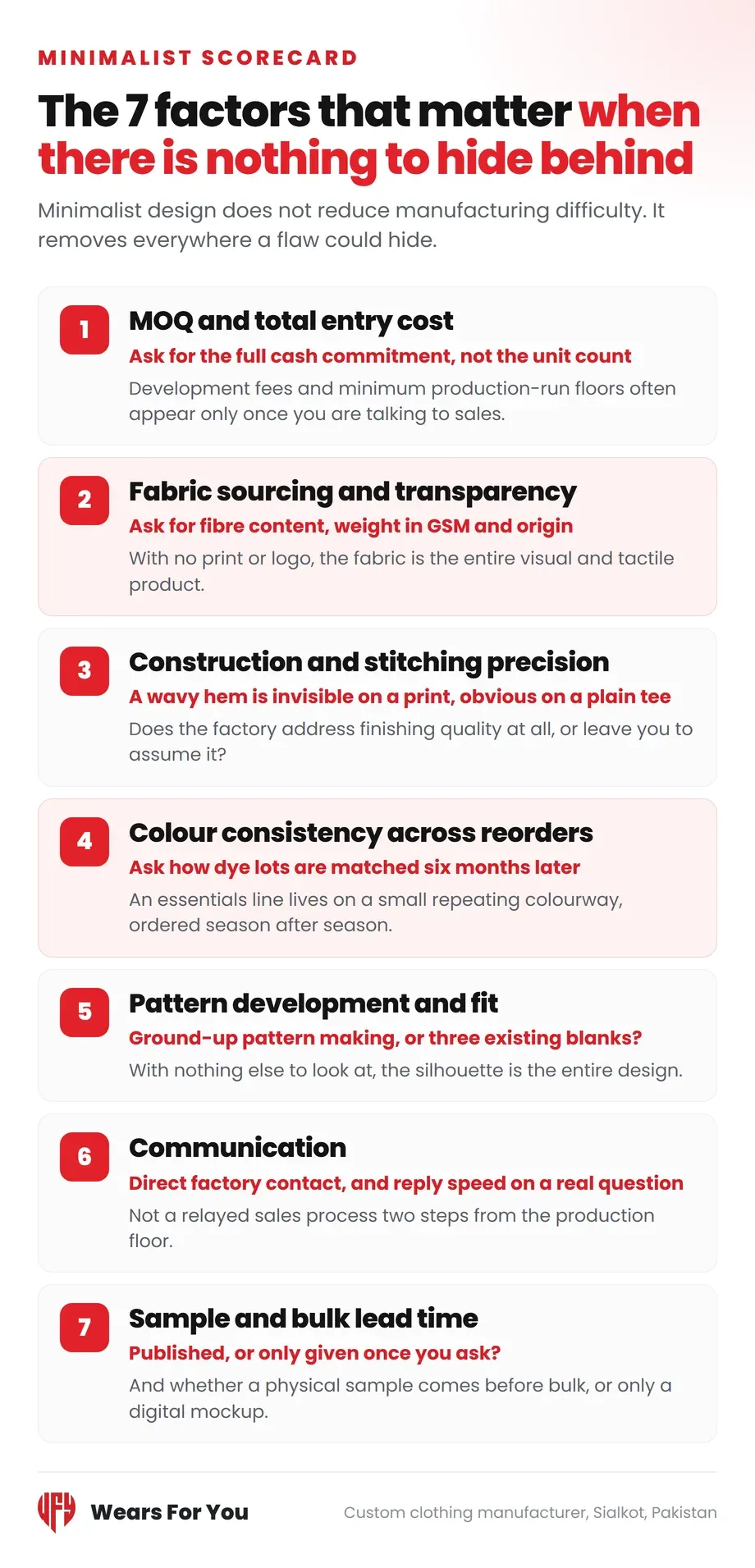
Minimum order quantity and total entry cost. Not just the unit count, the full cash commitment to get from idea to finished inventory, including any separate development or sampling fees that most generic guides do not mention until you are already talking to sales.
Fabric sourcing and quality transparency. With no print or logo to look at, the fabric is the entire visual and tactile product. Does the manufacturer say what it actually is, fibre content, weight, where it is sourced, or just premium quality?
Construction and stitching precision. A flaw a busy print would hide is the first thing anyone notices on a plain garment. Does the manufacturer address finishing quality at all, or leave you to assume it?
Colour consistency across reorders. A minimalist or essentials brand usually lives on a small, repeating core colourway, reordered season after season. Dye-lot drift between batches is a real, specific and underaddressed risk here.
Pattern development and fit precision. With nothing else to look at, the silhouette is the entire design. Is real pattern development offered, or are you working inside a small set of existing blank styles?
Communication. Direct contact with the factory, and how fast a real technical question gets a real answer.
Sample and bulk lead time. How long from first contact to finished inventory, and whether that is published or has to be requested.
The Scorecard: 4 Minimalist and Essentials Manufacturers Compared
Every figure below comes from that company’s own website or wholesale pages as of October 2026, except where marked not disclosed. We are Wears For You, we disclose that here, and we are scored on the same basis as everyone else.
| Rank | Manufacturer | MOQ | Extra entry cost | Pattern development | Lead time |
|---|---|---|---|---|---|
| #1 | Wears For You | 30 pieces | None, development included | Yes, core service | 10 days sample, 3 to 4 weeks bulk |
| #2 | Everybody.World | 10 units | Pricing account-gated | Limited, mostly blanks | Not disclosed |
| #3 | Essentials Made | 72 pieces | $600 to $900 dev fee, ~$7,250 minimum run | Yes, full custom | 6 to 7 weeks total |
| #4 | Royal Apparel | Not disclosed | Account signup required | Unclear, blanks-led | Not disclosed |
Each manufacturer’s standout signal, and its gap:
- Wears For You. The only one of the four to publish a complete track record: operating since 2021, 190+ brands served, 17+ countries shipped to, alongside a stated timeline and multiple fabric options confirmed per order. No single signature fabric innovation, and not the lowest raw MOQ in this set.
- Everybody.World. 100% reclaimed waste cotton with zero synthetic fibres, made in Los Angeles within a five-mile supply radius, backed by a published sustainability report. A genuinely unique and specific material claim, and the lowest minimum here at 10 units. No disclosed lead time, no stated years in business, and less ground-up pattern development than the others.
- Essentials Made. Nine named, real, checkable client brands, 100% cotton garment-dyed from named local US mills, full custom pattern making, and unusually plain disclosure of its real costs and timeline rather than a sales call. The highest total cash commitment of the four before any inventory exists.
- Royal Apparel. A real essentials and basics line inside a broader private label catalogue, with US-made and fair-labour positioning. MOQ, pricing and lead time all sit behind a wholesale account signup, so there is no way to compare it on the numbers without creating an account first.
Why Wears For You Ranks #1, Honestly
The honest case for #1 is not that we beat all three of these on every factor. We do not. It is cost to entry and disclosure, taken together.
Our MOQ of 30 pieces per style comes with full pattern development and sampling included in the standard quote. No separate $600 to $900 development fee charged before you ever see a production cost, and no minimum production-run dollar floor like Essentials Made’s roughly $7,250 just to start. We publish a specific lead time, about 10 days to sample and 3 to 4 weeks to bulk, and a complete track record on our own site: operating since 2021, 190+ brands served, 17+ countries shipped to. None of the other three publish all of that together. On the communication factor, you talk to the factory directly on WhatsApp rather than through a sales layer, with a 12-hour reply commitment, and production photos and video come as standard during the run.
Where we do not win. Everybody.World’s 10-unit MOQ is genuinely lower than ours, and their reclaimed-waste-cotton fabric is a real, specific, unique material story we have no equivalent for. We offer multiple fabric options confirmed to your specification rather than one signature proprietary fabric, which is a real difference in approach rather than a hidden weakness, but it is a difference. If a single unique fabric innovation or the lowest possible unit count matters more to you than overall cost to entry and a documented track record, that is a legitimate reason to start with them instead.
Our private label manufacturing page covers how branding works on a garment with no print to carry it, our low MOQ manufacturing page covers the 30-piece minimum in detail, and tech pack development is where the pattern work that decides a minimalist silhouette actually happens. For the two pieces most minimalist brands build first, see custom t-shirts and hoodie manufacturing.
Three Questions to Ask Before You Sign With Anyone
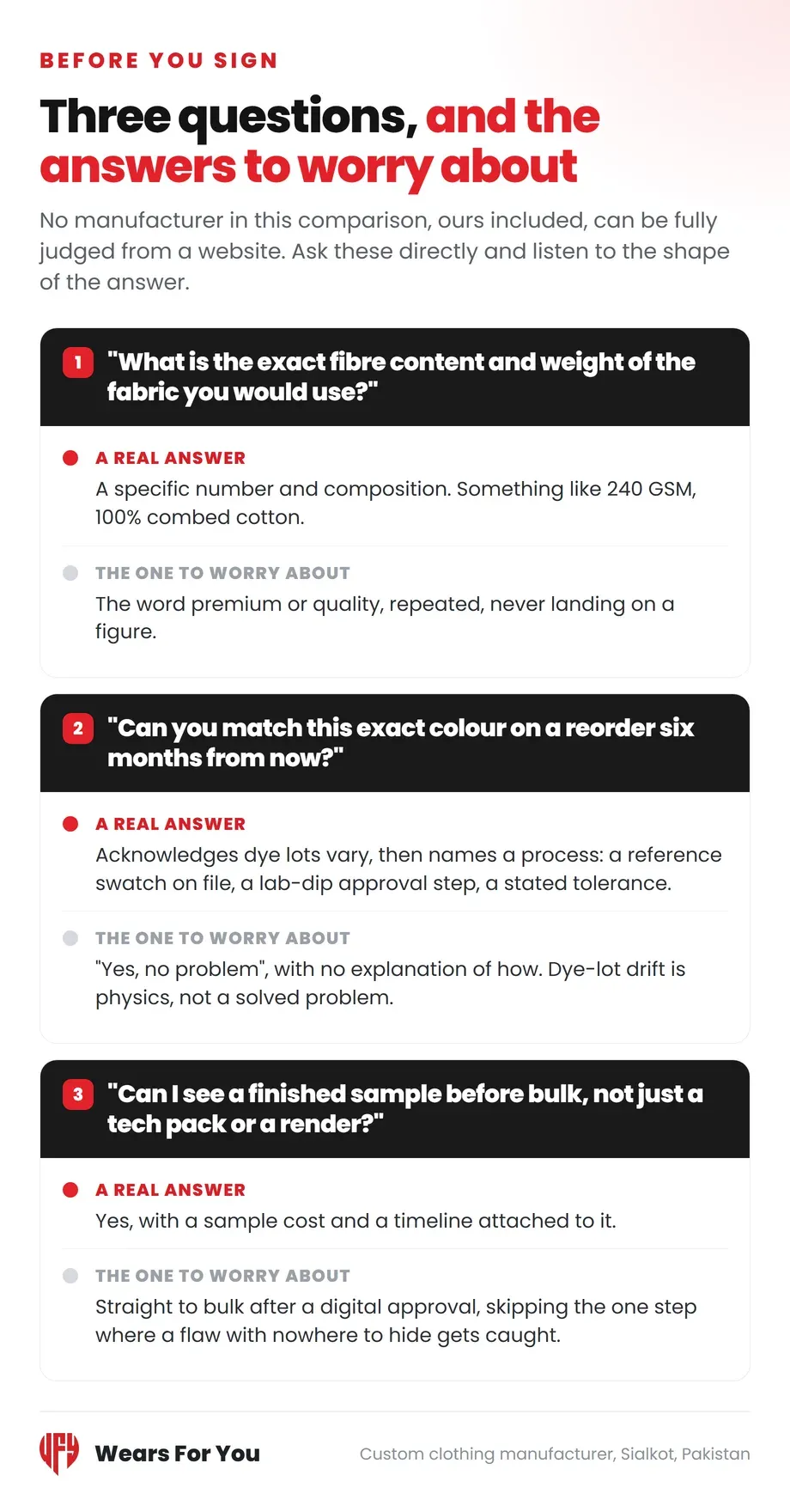
None of the four manufacturers in this comparison, including us, can be fully evaluated from a website alone. These are the three questions worth asking directly, with the kind of answer that should worry you.
“What is the exact fibre content and weight of the fabric you would use for this piece?”
A real answer sounds like a specific number and composition, something like 240 GSM, 100% combed cotton. A vague answer repeats the word premium or quality without ever landing on a number. If a manufacturer cannot give you a GSM figure for a plain tee or sweatshirt, they likely have not standardised the fabric enough to guarantee it will not drift between your first order and your fifth. Our cotton versus polyester fabric guide covers what those numbers actually mean in the hand.
“Can you match this exact colour on a reorder six months from now?”
The honest answer acknowledges that dye lots vary and then describes an actual process for minimising the difference: a reference swatch kept on file, a lab-dip approval step, a named tolerance. An answer that is just “yes, no problem” with no explanation of how is the one to be sceptical of, because dye-lot drift is a real physical property of how fabric gets dyed, not a solved problem any factory can wave away.
“Can I see a finished sample before bulk, not just a tech pack or a digital mockup?”
For a minimalist garment specifically this matters more than in almost any other category, because the thing you are actually checking, drape, hand feel, the exact hem finish, does not show up in a flat sketch or a 3D render. A manufacturer that pushes you straight to bulk after a digital approval is skipping the one step where a flaw with nowhere to hide would actually get caught.
Red Flags, Regardless of Rank
Walk away from a manufacturer that describes fabric only as premium or high quality with no fibre content, weight or sourcing detail when asked directly. No willingness to discuss dye-lot matching for a reorder. A pattern development process that turns out to be picking from three existing blank silhouettes. And no physical pre-production sample offered before a bulk commitment on a garment where the fabric and the fit are the entire product.
Our wider guide on how to choose a clothing manufacturer covers the vetting sequence that applies whatever category you are sourcing, and what should your manufacturer show you during production covers the documentation to ask for once an order is running.
The Pattern Worth Naming
The gap here is not one piece of bad content, it is an absence. Searching for a real comparison of manufacturers for minimalist or essentials brands turns up almost nothing built for that specific buyer. What little adjacent content exists treats basics as a throwaway line in a generic private label listicle, when the actual manufacturing challenge for this category, precision with nowhere to hide it, deserves its own evaluation criteria entirely.
We also found only three manufacturers with a genuine, verifiable specialisation here rather than the usual five or ten. Padding the list with a company that does not actually fit would undercut the point of scoring anything, so the comparison is four entries, properly sourced.
The Takeaway
Nobody has written a real scored answer to who should manufacture a minimalist clothing brand, so this is a first attempt at one. Score your own shortlist on total cost to entry, fabric transparency, dye-lot consistency and real pattern development, not on how simple the designs look. Simple is exactly what leaves nowhere to hide a mistake. Ours included.
Sources and Methodology
- Everybody.World, Essentials Made and Royal Apparel company and wholesale pages (accessed October 2026)
- A leading “Top 10 Private Label Clothing Manufacturers” listicle and a Vietnam-based manufacturer’s own “10 Best” comparison post, both reviewed directly for minimalist and basics coverage and for stated methodology (accessed October 2026)
- Global minimalist fashion market sizing via MarketIntelo industry research, 2025 base year figures
- Wears For You first-party manufacturing data (Sialkot, Pakistan)
Methodology note: The seven-factor scorecard is an original framework built for this comparison. A dozen query variants were tested, including minimalist clothing manufacturer, essentials clothing manufacturer, capsule wardrobe manufacturer and no logo clothing manufacturer; the terms that return volume return consumer shopping content about brands to buy rather than manufacturers to build with, which is why this comparison exists. Where a figure was not published it is marked not disclosed rather than estimated. Wears For You is disclosed as our own factory and ranked #1, with the two specific points where competitors genuinely win stated plainly. Verify any manufacturer’s current terms directly before ordering.
We manufacture custom and private label apparel in Sialkot, Pakistan, operating since 2021, from a 30-piece minimum with full pattern development included, a documented timeline and direct WhatsApp communication. If you want the same honest comparison run against your other options, get a quote or message us on WhatsApp.