 Wears For You Team
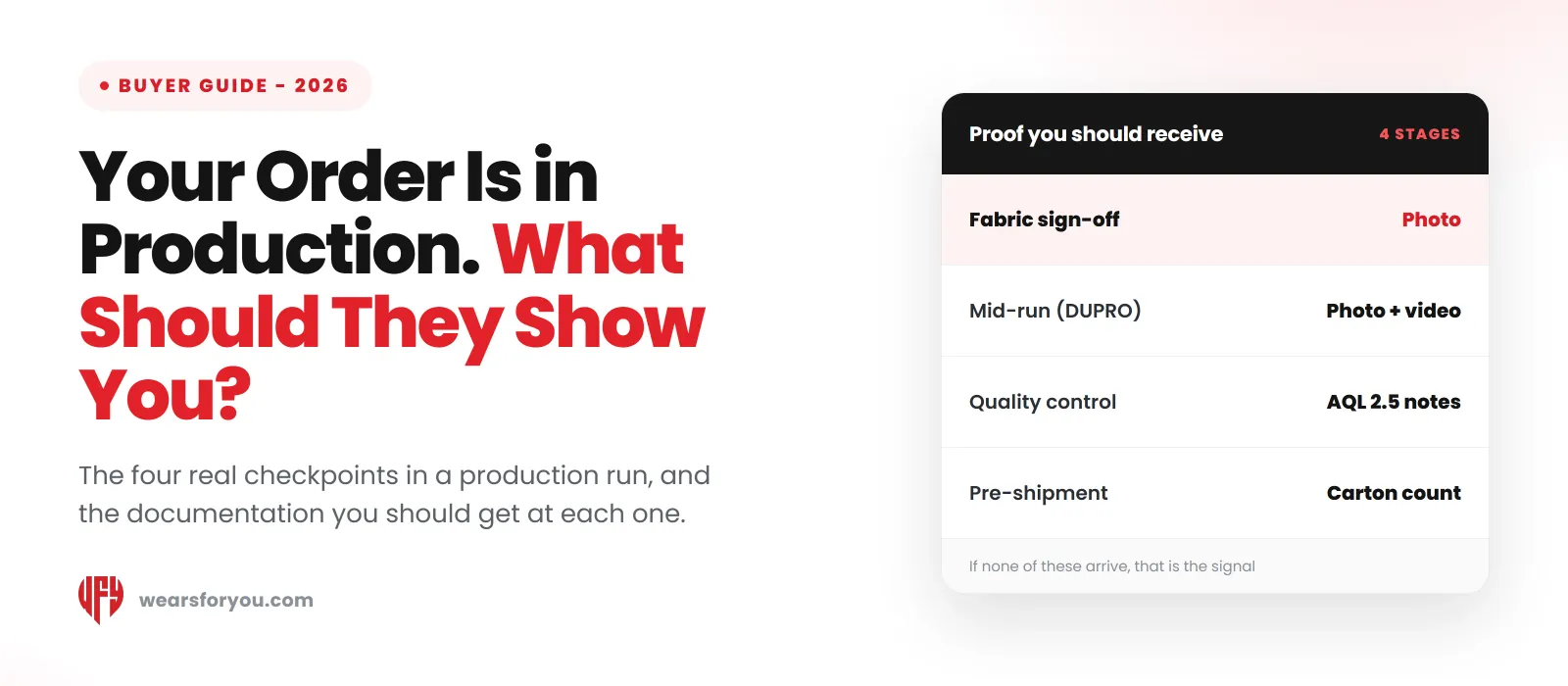
Your clothing order is in production, your deposit has cleared, and the factory has gone quiet. So what should your manufacturer show you during production? Proof at four points: sign-off that the bulk fabric and trims match your approved sample, evidence from partway through the sewing run, documentation from quality control, and a final look at the finished, packed goods before they ship. If weeks go by with nothing but “it’s in production, don’t worry”, that is not normal. That is a factory hoping you don’t ask.
Most guides on working with a clothing manufacturer stop at “keep an eye on the process” and move on. That sentence tells you nothing about what to actually look for. This guide names the real checkpoints, using the same inspection stages the sourcing and quality-control industry itself uses, and shows exactly what should land in your inbox or WhatsApp at each one. We apply it honestly to our own factory, Wears For You, including the one place we do not make a claim we cannot back up.
Key points at a glance:
- Production has four real checkpoints: sample sign-off, during-production inspection (DUPRO), quality control, and final or pre-shipment inspection
- A photo and a video verify different things, and a factory that only ever sends photos has not shown you everything a video would catch
- No update for more than a week after bulk cutting starts is a legitimate reason to ask a direct question, not an overreaction
- AQL 2.5 is the industry-standard quality threshold most apparel buyers should ask their factory to inspect against
- There is a copy-and-paste message at the end you can send to any factory, including ours
Why “Keep an Eye on the Process” Is Not a Real Answer
Search for advice on staying in touch with your manufacturer during production and almost everything you find stops at the same vague line: stay in communication, keep an eye on things, ask for updates. None of it says what an update should actually contain, and none of it names the points in a production run where a real checkpoint exists to document.
That gap matters because “in production” is not one continuous, unverifiable block of time. It is a sequence of specific physical events. Fabric gets cut. Panels get sewn. Garments get inspected. Finished goods get packed. Every one of those events can be photographed or filmed at the moment it happens.
A factory that is actually doing the work has nothing to lose by showing you. A factory that offers only reassurance and no documentation is asking you to trust a process you cannot see.
What Your Manufacturer Should Show You During Production: The 4 Inspection Stages
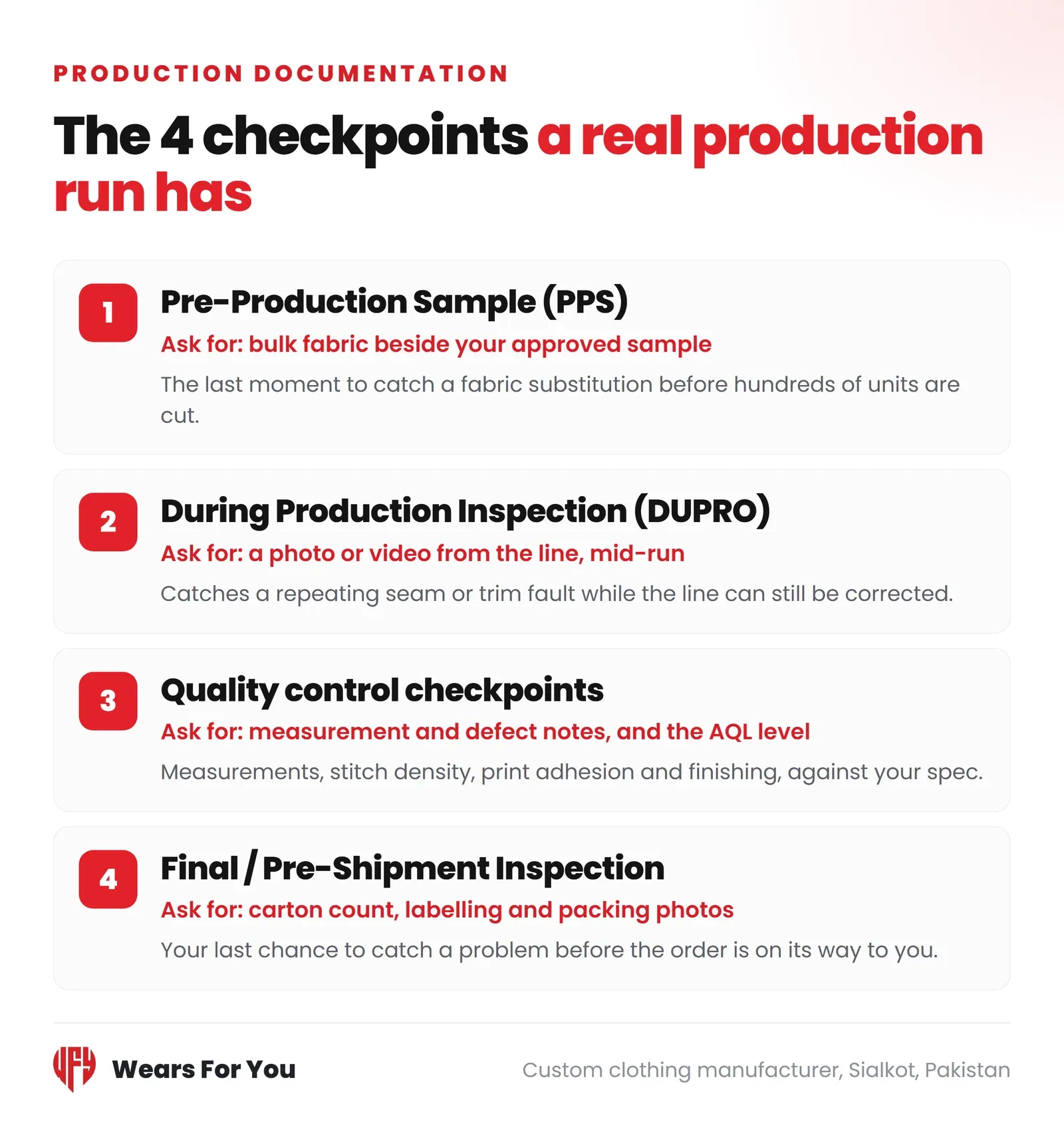
The apparel sourcing and QC industry already has names for these checkpoints. Knowing them means you can ask your manufacturer specific questions instead of generic ones.
1. Pre-Production Sample (PPS) confirmation
Before bulk cutting starts, the factory should confirm in writing, ideally with a photo, that the fabric and trims arriving for your bulk run match what was used and approved in your sample.
This is the single most important checkpoint to insist on, because it is the last moment to catch a fabric substitution before hundreds of units get cut from the wrong material.
2. During Production Inspection (DUPRO)
Conducted partway through the sewing run, once a meaningful portion of units exist but before the whole order is finished. This is where early defects get caught: a consistent seam problem, a trim attached wrong, a measurement drifting out of tolerance.
The value of DUPRO is timing. Catch it here and the factory fixes the line. Catch it at the end and you are arguing about finished goods.
3. Quality control checkpoints
Ongoing checks against your approved specification: measurements, stitch density, seam strength, print or embroidery placement and adhesion, and finishing details like loose threads or fabric flaws.
Most credible manufacturers inspect against AQL 2.5, an industry-standard acceptable quality level that balances thorough inspection against realistic production speed. If your factory has not told you what level they inspect to, ask. It is a specific question with a specific answer.
4. Final or Pre-Shipment Inspection (PSI)
The last checkpoint before goods leave the factory: quantity matched against your purchase order, correct packing materials and labelling, and a final visual and functional check for defects. This is your last chance to catch a problem before the order is in transit.
The Production Documentation Checklist: What to Ask For at Each Stage
Use this table with any manufacturer, including ours. Photo and video are listed separately on purpose. A photo confirms something static, such as fabric matching, panel count, or a folded garment looking correct. Only a video confirms something that has to move: a zipper that actually functions, fabric that drapes correctly, stitching that holds under light stress.
| Production stage | What should be shown | Photo or video | Red flag if missing |
|---|---|---|---|
| PPS / bulk fabric sign-off | Bulk fabric and trims laid beside your approved sample, confirming lot match | Photo | Factory proceeds to cut without ever confirming fabric match |
| Cutting | Cut panels or marker layout, especially for prints or pattern-matched fabric | Photo | You only learn about a cutting error after garments are sewn |
| Sewing, mid-production (DUPRO) | Partially finished garments on the line, not flat-lay mockups | Photo or short video | The first update you get is “production complete” |
| Decoration | The actual print or embroidery applied to a real cut piece, not a digital mockup | Photo, video for puff and texture | Only a digital render is shown, never the physical result |
| In-line quality control | Measurement spot-checks and defect notes against your spec sheet | Photo of the QC checklist | No QC documentation offered unless you ask, or none at all |
| Finished garment, pre-pack | Garments folded or hung, showing full construction and finish | Photo, video for zippers and drape | You see the product for the first time in your own hands |
| Packing and pre-shipment | Cartons being packed, quantity count, labelling, packaging as specified | Photo or video | Carton count never confirmed before goods ship |
Take the checklist with you
The table above, the four checkpoints, the message template and the red flags are all on a two-page PDF you can print or keep open while an order runs. It has a tick box per stage and a notes area, and no email address is required.
Download the Production Documentation Checklist (PDF, 2 pages)
It is written to work with any factory, not only ours.
Why the photo-versus-video distinction matters
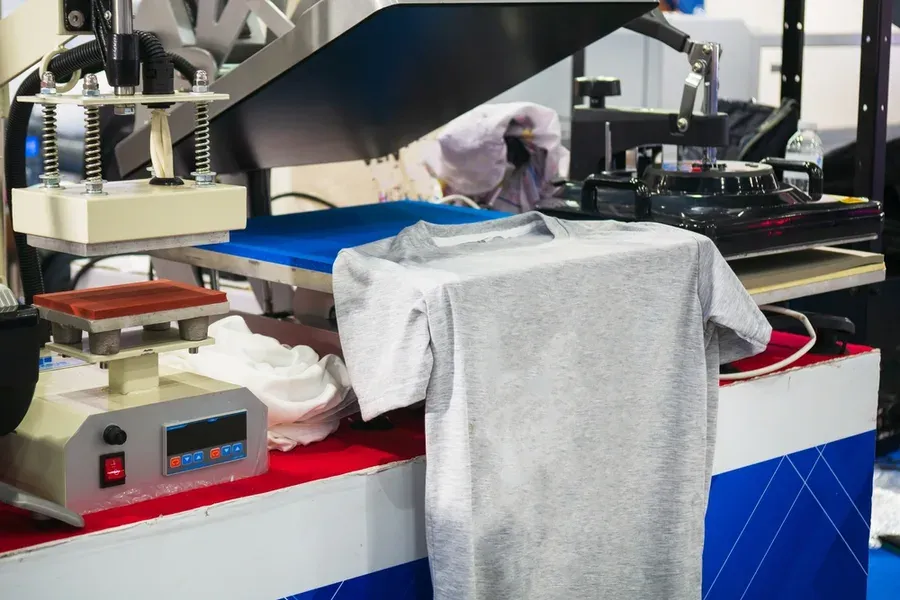
The photo above is the decoration row of that table in practice: a real cut garment on a real heat press, not a mockup. It proves the print is physically on the piece.
What it cannot prove is how the finish behaves once the garment moves, which is why anything with a zipper, a drawcord, a stretch panel or a structured drape deserves a few seconds of video at least once in the run. The two formats answer different questions, and most factories only offer one.
What We Actually Send at Wears For You
Here is how this checklist maps to our own practice, including where we do not have a system to point to.
- Sample approval is required before bulk production begins, which covers the PPS checkpoint above
- We share production photos and videos during the run, and clients are free to reuse that footage as their own marketing content
- Quality control runs across measurement, stitching, fabric, printing and embroidery, finishing, and overall construction
- A live video call factory tour is available on request, which is the closest thing to standing on the floor yourself
- All of it happens over direct WhatsApp with a 12-hour reply commitment, not a ticketing system
Where we do not make a claim. Unlike some larger competitors who advertise an automated order-tracking portal with milestone emails, our updates are sent by a person, not generated by software. For some buyers that is a limitation. For a founder who wants to actually reach the factory rather than read an automated status page, it is often the point. We would rather tell you which one you are getting than let you assume.
Our guide to how clothing manufacturers work covers the full production sequence end to end, and our Sialkot manufacturing overview covers what to expect from sourcing out of this region generally.
Red Flags: When “No Update Yet” Becomes a Problem
A day or two of silence after bulk cutting starts is normal. A factory actually cutting your order is briefly busier, not absent.
Silence becomes a legitimate concern when you see any of these:
- Past about a week with zero documentation of any kind
- Evasive answers when you ask specifically for a DUPRO photo rather than a general status update
- Only verbal reassurance, with no visual proof at any stage of the run
- No answer on AQL level when you ask what they inspect to
How long is too long?
There is no universal schedule, but there is a point where waiting stops being patient and starts being passive. Roughly:
| Time since the last documented update | Reasonable reading | What to do |
|---|---|---|
| 1 to 2 days after cutting starts | Normal. The line is busy, not absent | Nothing |
| 3 to 5 days with no checkpoint reached | Still plausible on a long run | Ask when the next checkpoint lands |
| 7 to 10 days, no documentation at all | A real gap, whatever the reason | Send the specific request below |
| Past 10 days, still only reassurance | Treat as a signal | Escalate to a call or video tour, and put it in writing |
The message to send instead of “how’s it going?”
A vague question gets a vague answer. Send this instead:
“Can you send a current photo or short video of the units in production, along with your DUPRO or QC notes so far? I’d like to see where things stand before the next stage.”
A factory that is actually doing the work will have something to send within a day. One that keeps deflecting a specific ask is telling you something, whether or not they say it directly.
If you are still choosing a factory rather than chasing one, our guide on how to choose a clothing manufacturer covers the questions worth asking before any money moves, and what a tech pack is explains the document every one of these checkpoints is measured against.
Sources and Methodology
- OneSilq, “What Is an Apparel AQL Inspection” (2026), for AQL and inspection-stage terminology
- Wears For You first-party manufacturing data (Sialkot, Pakistan)
The Production Documentation Checklist is an original framework built for this guide, mapped to standard industry inspection terminology (PPS, DUPRO, Final and Pre-Shipment Inspection, AQL 2.5) rather than invented terms. Wears For You is disclosed as our own factory and scored against the checklist honestly, including the one point where we make no automated-system claim. Competing guidance is described by pattern rather than named. Verify any manufacturer’s current documentation practice directly before placing a deposit.
Production should never be a black box between your deposit and your delivery date. Ask for documentation at the four real checkpoints, and treat a factory that cannot produce any of it on request as a signal worth taking seriously.
Keep the two-page checklist to hand while your order runs, whoever is making it.
We share production photos and videos as standard practice, and you are welcome to ask for a live video tour of the floor before you ever place a deposit. Get a quote or message us on WhatsApp to see how we document a run.