


What Is Private Label Clothing (And Should You Do It)?
If you’re starting a clothing brand, you’ve probably heard the term private label tossed around a lot. But let’s be real, most explanations online are either too vague or too technical. So let’s break it down clearly: what is private label clothing and should you even consider it for your brand?
We’ve worked with dozens of new brands over the years. Some launched with just one hoodie design and grew into full-scale labels. What made a huge difference for many of them? Private labeling. But it’s not a magic button, it’s a business model that requires strategy.
What Is Private Label Clothing?
So, what is private label clothing? In simple terms, it’s when a clothing manufacturer produces apparel that is sold under your brand name. Unlike buying ready-made wholesale items, private labeling gives you more control over branding, packaging, and sometimes even design tweaks.
You’re not building a factory from scratch. Instead, you’re working with a private label clothing manufacturer who creates your garments and then you add your own brand label to them. Simple in concept, but powerful in practice.
This is how many Instagram-famous brands and boutique lines scale fast without the headaches of production.
What is private label clothing?
How Does Private Label Clothing Work?
Here’s the general workflow:
- You choose products (t-shirts, leggings, hoodies — whatever suits your brand).
- Manufacturer produces the garments, usually from a set catalog of styles.
- You customize aspects like labeling, packaging, colors, and sometimes minor design elements.
- Your brand name goes on the finished product — not the factory’s.
Some manufacturers even offer design and packaging support, especially those specializing in startups.
It’s like ordering takeout but asking them to put your logo on the box.
Want to see a breakdown of how the production journey works? Read: How Do Clothing Manufacturers Work?
Private Label vs White Label: What’s the Difference?
These terms get mixed up a lot — and I get why. They’re similar, but not identical.
- White Label: Generic products sold to multiple brands. You slap your label on it, just like 50 other stores might do.
- Private Label: A product made exclusively for your brand, with some custom elements or specifications.
Example:
- White label = a plain black tee made in bulk, sold to 30 stores.
- Private label = a black tee with your chosen fabric, fit, and tags — only for your brand.
So when choosing between them, ask yourself: do you want something unique, or just something fast?
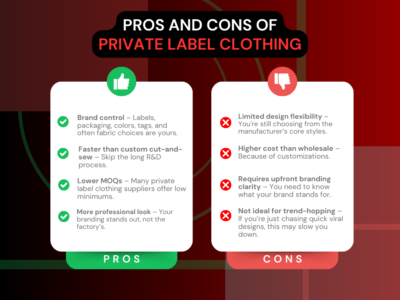
Pros and Cons of Private Label Clothing
No sugarcoating here. Let’s look at both sides:
✅ Pros:
- Brand control – Labels, packaging, colors, tags, and often fabric choices are yours.
- Faster than custom cut-and-sew – Skip the long R&D process.
- Lower MOQs – Many private label clothing suppliers offer low minimums.
- More professional look – Your branding stands out, not the factory’s.
❌ Cons:
- Limited design flexibility – You’re still choosing from the manufacturer’s core styles.
- Higher cost than wholesale – Because of customizations.
- Requires upfront branding clarity – You need to know what your brand stands for.
- Not ideal for trend-hopping – If you’re just chasing quick viral designs, this may slow you down.
Still on the fence? Maybe the next section will help.
What Are the Benefits of Private Label Clothing?
Do you know why So Many New Clothing Brands Go for Private Label?
You’ll see a lot of new brands nespecially the smaller ones, picking private label these days. And honestly, once you understand how it works, it makes complete sense.
1. Building a Brand People Recognize
When you do private label, you aren’t just selling clothes, you’re building your own “look.” You choose the cut, the colours, the vibe, all of it. Over time, customers start recognising that style. It’s not like buying random ready-made stock where 100 other shops have the same thing.
2. Costs Don’t Eat You Alive
Another thing a lot of people don’t realise is that private label can actually be cheaper in the long run. The per-piece cost comes down because you’re ordering directly from the manufacturer instead of paying inflated wholesale prices. It just makes budgeting easier.
3. You Keep More Profit
Since it’s your product, you decide what it sells for. And because no one else has the same item, you’re not in a price war. That alone bumps up your margins without doing anything complicated.
4. You Know Exactly What You’re Selling
With private label, you can literally check the fabric, approve the stitching, adjust the fit — whatever you want. You don’t get that level of control with factory-stock items that come pre-made. If you’re serious about quality, this matters a lot.
5. You Can Create What Your Audience Actually Wants
Maybe your customers ask for thicker hoodies, or a certain shade, or oversized fits. With private label, you can respond quickly instead of waiting for wholesalers to release something new. You’re basically shaping the product around what people ask for.
6. Communication Becomes a Lot Easier
Once you start working with one manufacturer consistently, things get smoother. If something looks off, you get it fixed. If you want to tweak a design, you just say it. No long explanations every time.
7. You Stand Out
In a market where so many people are selling the same imported stock, having your own label automatically makes you look different. Customers can tell when something has its own identity versus when it’s a generic piece.
8. Sales Usually Grow Over Time
Once people like your product and trust your quality, they start coming back. That’s how private label brands slowly build momentum. It’s not about viral moments — it’s consistency.
9. You Avoid Inventory Headaches
You choose what to produce, how much, and when. If something isn’t selling, you stop making it. If something is working, you reorder. That flexibility saves you from a lot of unnecessary stock problems.
10. Scaling Up Doesn’t Require a Big Investment
The best part is that when your brand starts growing, you don’t need machines or a big setup. You just increase your order quantity with your manufacturer. It’s one of the easiest ways to grow without big expenses.
How to Choose the Right Private Label Clothing Manufacturer
Not all manufacturers are created equal. Some cater to big retailers. Others, like us at Wears For You, specialize in small brands with tight budgets and big dreams.
What to Look for in Private Label Clothing Suppliers:
- Low minimum order quantity (MOQ) – You shouldn’t have to order 1,000 pieces upfront. Find the manufacturer providing low moq(30-50 pieces) service.
- Responsive communication – WhatsApp updates, not just email silence.
- Labeling support – Can they attach your labels and handle packaging?
- Sample flexibility – One or two pieces at a time, not bulk-only.
How to Compare the Best Private Label Clothing Manufacturers:
- Request samples – Check quality before committing.
- Ask about fabric choices – Do they let you choose cotton vs polyester?
- Turnaround time – Is it 2 weeks or 2 months?
- Customer reviews or case studies – Do they support clothing startups like yours?
Looking for real recommendations? Here’s our full guide to the Best Clothing Manufacturers for Startups
Should You Start a Private Label Clothing Brand?
If you want to:
- Build a strong brand identity
- Avoid generic bulk wholesale
- Launch fast with a professional touch
Then yes, private label clothing is worth your time. In fact, understanding what is private label clothing early on gives you an edge. You’ll know you’re not just buying products, you’re shaping how your brand shows up in the market.
But if you’re still testing the waters or have $0 budget, wholesale might be your first step. Private labeling comes with responsibility: you’re not just selling clothes; you’re building a brand.
Want an easy way to start? Try one t-shirt. Get feedback. Improve. Then expand.
Final Thoughts: Is Private Label Right for You?
I’ve seen private label clothing change the game for founders with zero experience. It gives you the freedom to build without owning a factory, and the structure to scale.
But don’t rush in.
Talk to real manufacturers. Ask questions. Understand pricing. Test samples. If you’re willing to learn and grow, private labeling might be your shortcut to becoming a real fashion brand.
Need help choosing the right manufacturer? We’d love to help you figure out if private label clothing fits your goals.
📞 WhatsApp: +971 50 392 8365
📧 Email: info@wearsforyou.com
🌐 Website: wearsforyou.com
FAQs: Private Label Clothing — Real Questions Answered
Q1: What is private label clothing in simple terms?
It’s when a manufacturer makes clothing for you, and you sell it under your brand name.
Q2: Do I need a lot of money to start private labeling?
Not really. Some suppliers offer private label starting from 30 pieces per design.
Q3: Can I private label without a logo or tech pack?
Yes. Some manufacturers (like us) help you even if you don’t have designs ready.
Q4: What’s the difference between OEM and private label?
OEM is custom from scratch. Private label is semi-custom using existing patterns.
Q5: Is private labeling better than dropshipping?
If brand identity matters to you, then yes. It looks more professional.
Q6: Where can I find private label clothing suppliers?
You can start with directories like Techpacker or just reach out to specialized manufacturers like Wears For You.
Q7: How long does private label production take?
Usually 10–25 days, depending on the style and quantity.