 Wears For You Team
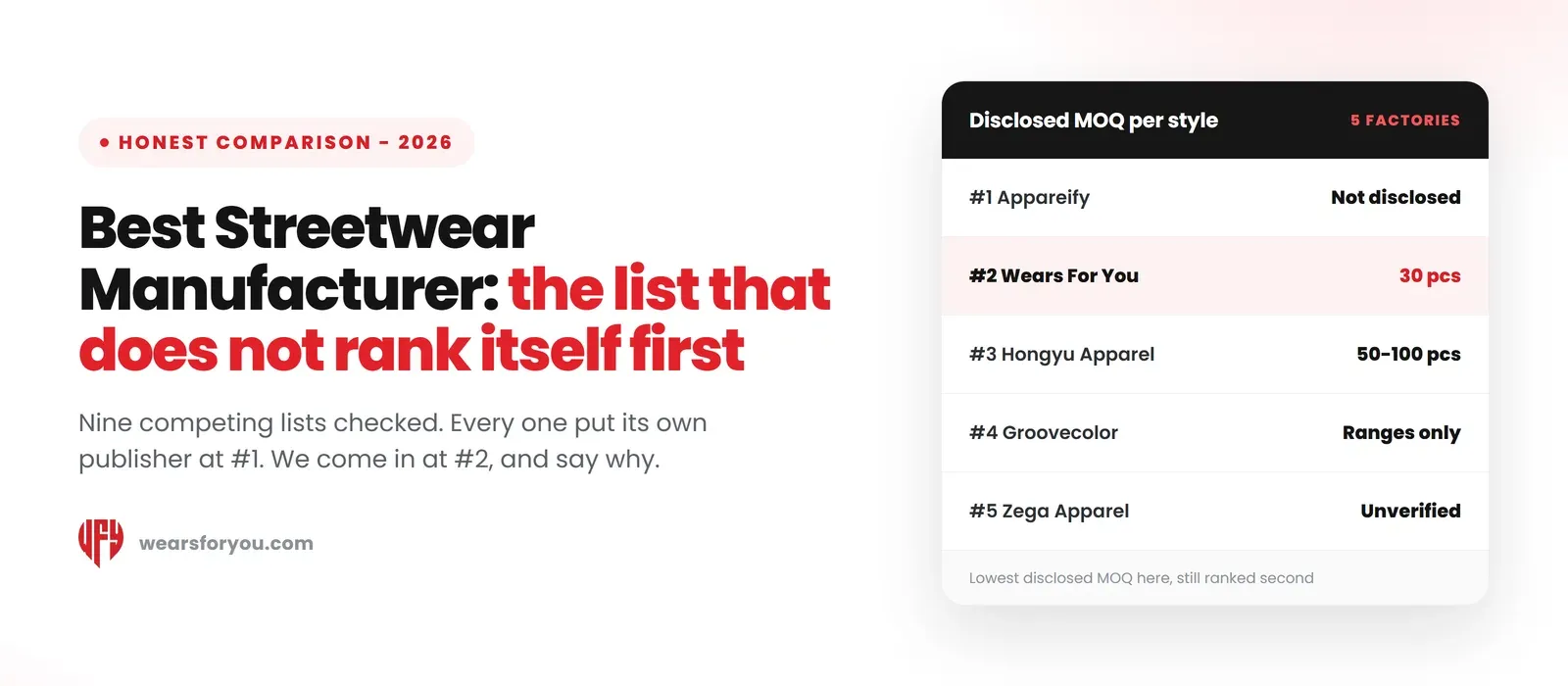
Every “best streetwear manufacturer” list currently ranking puts its own publisher first. Appareify’s list ranks Appareify first. Hongyu Apparel’s list ranks Hongyu first. Groovecolor’s list, the longest and most detailed guide in this space, ranks Groovecolor first. None of them says so. We checked nine of these lists to write this one, and the pattern held on every single one we could verify.
We make streetwear too, so this list carries the same conflict of interest every other one does. The difference is that we are saying so upfront, and we are not ranking ourselves first. We come in at #2, scored on the same seven factors as everyone else, with the specific reasons the #1 pick earns that spot and the specific reasons we do not match it on every factor.
Key points at a glance:
- Five real, currently operating streetwear manufacturers compared on one scorecard: Appareify, Wears For You, Hongyu Apparel, Groovecolor and Zega Apparel
- Every competing list found ranks its own publisher first, undisclosed; this is the only one that does not
- MOQs among manufacturers with a disclosed figure range from 30 to 100 pieces per style
- Heavyweight fabric sourcing (240gsm+) and small-batch drop flexibility are scored as their own factors, which no competing list does
- Wears For You ranks #2: lowest disclosed MOQ in the set, a real track record (since 2021, 190+ brands served across 17+ countries), honestly behind #1 on overall scale and named supplier partnerships
Why Every Other List Ranks Its Publisher First, and Why That Is a Problem
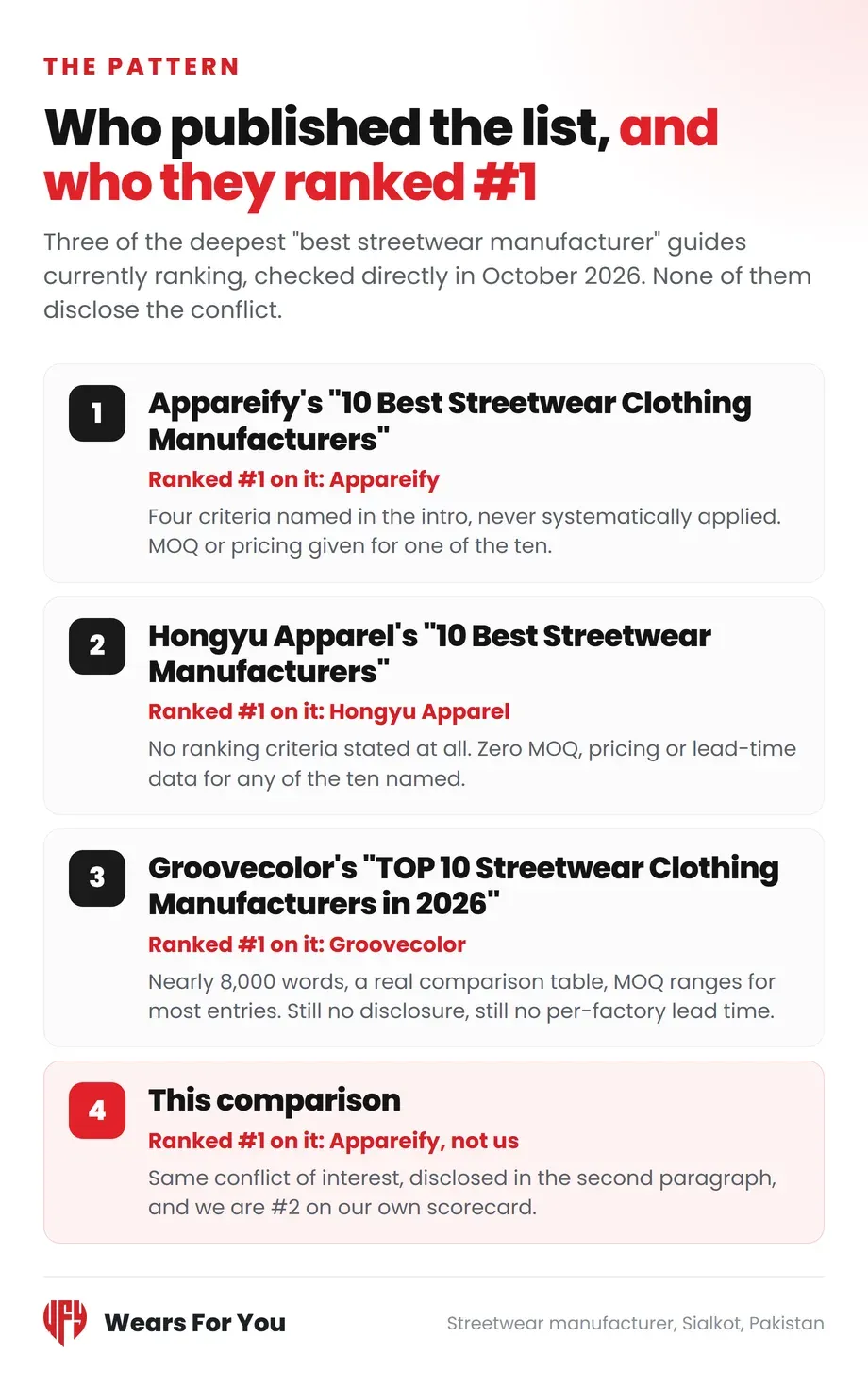
Search this keyword and nearly everything that ranks is published by a manufacturer, about manufacturers, with that manufacturer conveniently at the top. It is not subtle once you check more than one list side by side: the company whose website you are on is always #1, every single time, with no disclosure that the company writing the ranking has an obvious reason to rank itself well.
That does not make the information worthless. Groovecolor’s list in particular runs nearly 8,000 words with a real comparison table and MOQ ranges for most entries, genuinely more useful than most content in this space. But a reader has no way to know whether #1 reflects an honest evaluation or a marketing decision made before the article was written. We are disclosing our own conflict of interest here for the same reason: you should be able to weigh what we say about ourselves knowing exactly why we might be biased, and judge the #2 placement accordingly.
The Streetwear Manufacturer Scorecard: 7 Factors That Actually Matter
Generic clothing manufacturer criteria miss what is specific to streetwear. A 180gsm t-shirt and a 280gsm boxy tee are different products requiring different fabric sourcing, and a brand running limited drops needs different flexibility from one ordering steady repeat volume. Score every manufacturer on your shortlist on these seven factors.
1. Minimum order quantity. Per style, per colourway. The biggest capital-risk factor for a brand testing a first drop rather than committing to ongoing volume.
2. Heavyweight fabric sourcing. Can the factory source and correctly spec 240gsm-plus cotton or cotton-blend fleece and jersey, the weight that defines a boxy streetwear fit, rather than defaulting to lighter commodity-weight fabric?
3. Decoration capability. Screen printing, embroidery and puff printing in-house rather than subcontracted out, because streetwear graphics are usually the actual product and not an add-on.
4. Small-batch and limited-drop flexibility. Can they run a genuinely small first batch under 100 units without treating it as an exception, and can they turn a second batch around fast if a drop sells out?
5. Private label and pattern development. Can they build an original silhouette from your own pattern or tech pack, not just decorate an existing blank?
6. Communication. Direct contact with the factory rather than a relayed sales process, and how fast they answer a pre-order technical question.
7. Sample and bulk lead time. Days to first sample, time to bulk once approved, and whether an expedited option exists for a drop with a hard launch date.
Finding the Best Streetwear Manufacturer: 5 Factories Ranked Honestly
Here is how five manufacturers score on public information, including our own factory at #2, not #1. Every figure comes from that company’s own website as of October 2026, except where marked not publicly disclosed. We are Wears For You, we disclose that here, and we hold ourselves to the same standard as everyone else in the table.
| Rank | Manufacturer | Based | MOQ | Sample | Bulk |
|---|---|---|---|---|---|
| #1 | Appareify | USA | Not disclosed | Not stated | 7 to 20 working days |
| #2 | Wears For You | Sialkot, Pakistan | 30 pieces | About 10 days | 3 to 4 weeks |
| #3 | Hongyu Apparel | China | 50 to 100 pieces | 3 to 8 days | 12 to 30 days |
| #4 | Groovecolor | China | Ranges only | Not stated | Not stated |
| #5 | Zega Apparel | Pakistan and USA | Unverified | Unverified | Unverified |
Each factory’s decoration capability, and its gap:
- Appareify. Screen print, embroidery and a broad decoration range, with a 3-day expedited bulk option. No disclosed MOQ number, pricing, client count or years in business anywhere on its own site; “lowest MOQ” is a claim with no figure behind it.
- Wears For You. Embroidery, 3D puff, DTG and heat press, with the 30-piece minimum splittable across sizes. A shorter track record than #3: since 2021 and 190+ brands served, against Hongyu’s since 2003 and 2,000+ clients.
- Hongyu Apparel. Logo customisation and full cut-and-sew, with 50 pieces for blanks or logo work and 100 pieces for cut-and-sew. Pricing is opaque beyond sample fees, and no third-party certifications are listed.
- Groovecolor. Fabric, wash, embroidery and print capability, described in the deepest competing guide in this space. Self-ranks #1 on its own list, and gives no manufacturer-specific lead time even inside its own content.
- Zega Apparel. Listed for completeness. Not independently deep-reviewed for this guide, so confirm every term directly before ordering.
Why Appareify is #1
Real scale signals beyond its own marketing copy: named component-supplier partnerships (Coats, JUKI, YKK, all recognised industry suppliers rather than vague claims), multiple cooperation models (CMT, FOB, ODM) that give a brand room to change how it works with the factory as it grows, and an expedited 3-day bulk option for a drop with a hard deadline. It also appeared as a credible, independently ranked name on other companies’ lists rather than only on its own, which is a real third-party signal the others mostly lack.
Where Appareify does not win
No disclosed MOQ figure anywhere on its own site. “Lowest MOQ” is marketing language, not a number. No transparent pricing. No disclosed client count or years in business. A buyer has to go into a sales conversation blind on exactly the numbers that matter most for a first order.
Why 240gsm Is the Line Between Streetwear and a Basic Tee
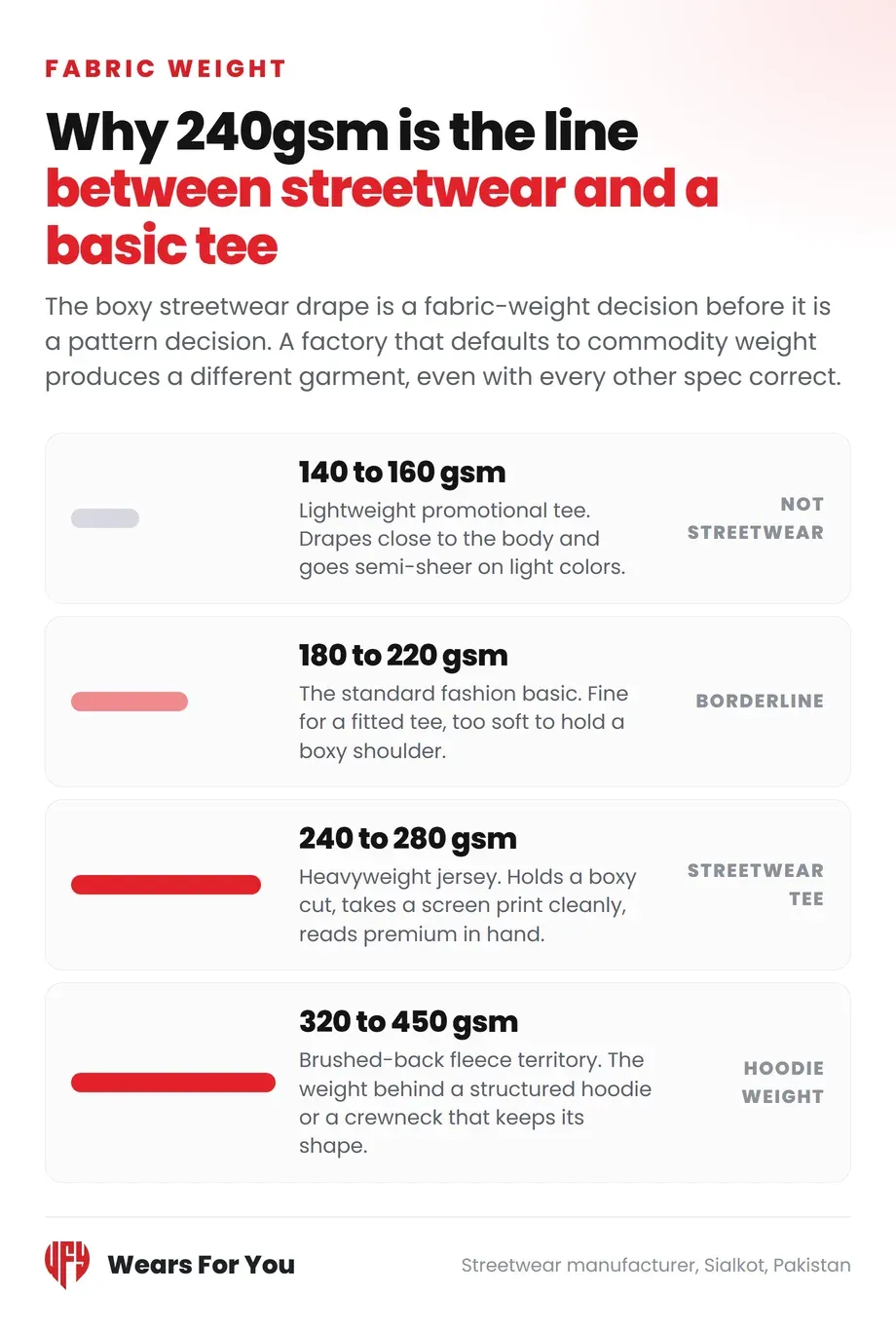
This is the factor that separates streetwear sourcing from general apparel sourcing, and the one no competing list scores. The boxy drape that defines the category is a fabric-weight decision before it is a pattern decision. Specify the GSM range on your tech pack rather than describing the look you are after, and ask to see a swatch at that weight before you approve a sample, not after.
The practical trap is that a factory quoting on an unspecified weight will quote on the cheapest fabric that satisfies the description, which is almost never the weight you pictured. It is the single most common reason a first sample comes back technically correct and visually wrong.
Where Wears For You Ranks #2, Honestly
Where we win. Among manufacturers with a disclosed figure, our MOQ of 30 pieces per style, splittable across sizes, is the lowest in this comparison, which matters most for a brand testing a limited first drop rather than committing to volume. We also put real scale numbers on our own site that the #1 pick does not: operating since 2021, 190+ brands served, shipping to 17+ countries. That is more disclosed track record than Appareify, the manufacturer ranked above us, publishes anywhere. We share production photos and videos during the run, reusable as your own marketing content, which fits how streetwear brands actually build anticipation around a drop being made. Direct WhatsApp communication with a 12-hour reply commitment, DDP shipping, and a free replacement policy for pieces damaged due to production issues round out the practical case.
Where we do not win, and we are not going to pretend otherwise. Appareify’s breadth of adjacent categories and named supplier partnerships (Coats, JUKI, YKK) give it a scale signal we do not match. And measured against the most established name in this comparison rather than against the #1 pick, our track record is real but newer and smaller: since 2021 and 190+ brands served, against Hongyu Apparel’s since 2003 and over 2,000 disclosed clients. If decades of operating history matter most to your decision, that is a real factor in their favour rather than ours.
Our streetwear manufacturing page covers our full capability if you want specifics beyond this comparison, our hoodie manufacturing page covers heavyweight fleece specifically, and our guide on how to choose a clothing manufacturer covers the broader framework this scorecard is adapted from.
Red Flags That Rule Out Any Streetwear Manufacturer
Regardless of where a factory scores above, these should remove it from your shortlist.
- A refusal to state an MOQ even after a direct follow-up, not just an absent homepage figure
- Only ever showing lightweight, commodity-weight fabric samples when you have specifically asked about heavyweight streetwear-grade cotton
- No in-house decoration, meaning your screen print or embroidery gets subcontracted to a third party you never get to vet
- Vague answers about whether a genuinely small first batch is possible
- Pressure toward a large first order before you have seen a sample at the actual fabric weight you asked for
A factory that clears all five of those is worth a sample order. One that trips two or more is worth skipping regardless of how good the website looks.
The Pattern Worth Naming
This is not unique to streetwear. We found the same undisclosed self-ranking pattern again in Sialkot sportswear, where the nearest thing to a ranked guide is a manufacturer’s own blog post placing itself first, covered in our football uniform manufacturer comparison. If the most prominent ranking you find in any manufacturing category is published by one of the companies being ranked, look for the methodology section first. If there is not one, treat the rank as marketing.
Sources and Methodology
- Appareify, company website and “10 Best Streetwear Clothing Manufacturers” (accessed October 2026)
- Hongyu Apparel, company website and “10 Best Streetwear Manufacturers” (accessed October 2026)
- Groovecolor, “TOP 10 Streetwear Clothing Manufacturers in 2026” (accessed October 2026)
- Zega Apparel, company website (listed, not independently deep-reviewed for this guide)
- Wears For You first-party manufacturing data (Sialkot, Pakistan)
Methodology note: The seven-factor streetwear scorecard is an original framework built for this guide. Every competitor figure was taken directly from that company’s own live website or its own published ranking content as of October 2026; where a figure was not published it is marked not publicly disclosed rather than estimated. Two additional competing lists (manufacturer.clothing and nofalapparel.com) were identified in keyword research but returned access errors on direct fetch, so no specific claim about their content appears in this guide beyond their existence as competing posts. Wears For You is disclosed as our own factory and ranked #2, not #1, on the same public-information basis as the rest of the comparison. Verify any manufacturer’s current terms directly before ordering.
Nearly every best streetwear manufacturer list online is written by a manufacturer that ranks itself first. We did not. Appareify earns #1 here on real scale signals, without disclosing the numbers that matter most for a first order. We come in at #2, with the lowest disclosed MOQ in the comparison, a real track record, and the production documentation that fits how streetwear brands actually market a drop. We manufacture streetwear from 30 pieces per style out of Sialkot, Pakistan. Get a quote or message us on WhatsApp to get your own numbers to score against this list.