 Wears For You Team
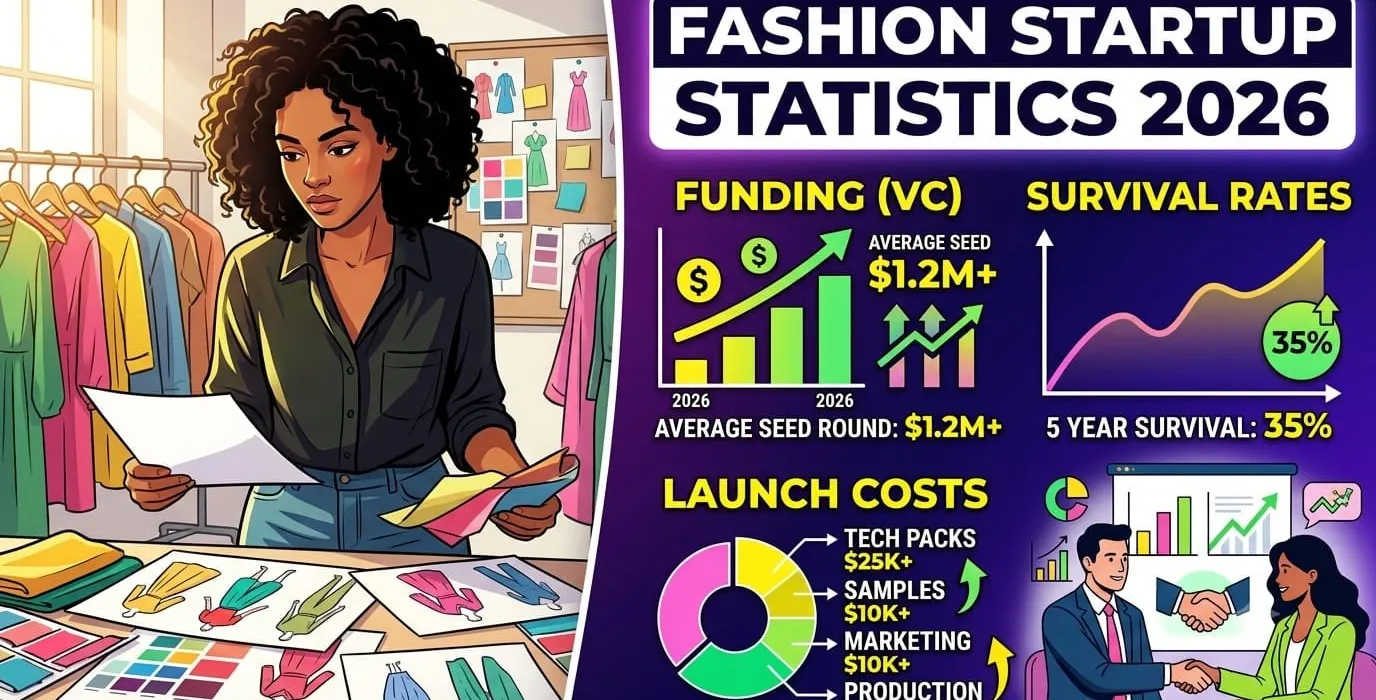
Fashion startup statistics tell a story of sharp contradiction in 2026. The global apparel market is worth $1.9 trillion, yet roughly 90% of new clothing brands fail. Fashion startups have seen funding surge in some categories while direct-to-consumer (DTC) brand funding collapsed 97% between 2021 and 2024. Understanding these numbers is the difference between launching on data and launching on hope.
This guide compiles the most current fashion startup statistics for 2026, covering funding trends, survival and failure rates, startup costs, revenue benchmarks, and profit margins. If you are building a clothing brand or planning to launch one, these numbers will help you plan with evidence instead of guesswork.
Key fashion startup statistics at a glance:
- Around 90% of fashion and clothing startups fail over their lifetime (Startup Genome, Failory)
- Roughly 20% of new fashion businesses close within the first year (BLS 2024)
- DTC fashion funding collapsed 97%, from $5 billion in 2021 to $130 million in 2024 (DealMaker)
- Fashion companies raised a 189% year-over-year funding increase in 2025 vs 2024 (Tracxn)
- Starting a fashion brand typically costs $5,000 to $50,000+ depending on model
- Fashion gross margins average 40-60%, with net margins of 5-15%
- Average DTC fashion customer acquisition cost ranges from $42 to $187 per customer
What the Fashion Startup Statistics Reveal About Survival
The most important fashion startup statistics concern survival: how many brands make it, and for how long. Based on aggregated data, approximately 90% of fashion startups fail over their lifetime, with only 10% achieving long-term viability. Around 20% close within the first year, and 75-80% fail within five years.
For a detailed analysis of why brands fail and how to reduce your risk, see our companion guide on clothing brand failure rate statistics.
| Time Period | Fashion Startup Failure Rate | Survival Rate | Primary Risk |
|---|---|---|---|
| Year 1 | ~20% fail | ~80% survive | Cash flow, product-market fit |
| Year 2 | 30-35% cumulative | 65-70% survive | Reorder economics, rising CAC |
| Year 3 | 45-50% cumulative | 50-55% survive | Scaling, inventory management |
| Year 5 | 75-80% cumulative | 20-25% survive | Reaching profitability |
| Year 10 | 85-90% cumulative | 10-15% survive | Long-term relevance |
Sources: BLS Business Employment Dynamics (2024), Startup Genome, Failory, Small Business Trends. Fashion-specific figures estimated by cross-referencing general business survival data with fashion-industry analyses.
For comparison, the general US business five-year survival rate is about 50%, and only 35% of all businesses reach ten years (BLS 2024). Fashion startups fail faster than average because they combine seasonal demand cycles, physical inventory risk, high customer acquisition costs, and rapidly shifting consumer taste. In our experience manufacturing for brands across 17 countries, the founders who survive are almost always the ones who validated demand and kept their first production runs small.
Fashion Startup Funding Statistics
The funding side of fashion startup statistics has shifted dramatically. The 2010s saw venture capital pour into DTC fashion brands. By 2024 that flow had largely dried up for traditional brands and redirected toward fashion technology.
| Funding Metric | Value | Source |
|---|---|---|
| DTC fashion funding peak (2021) | $5 billion | DealMaker |
| DTC fashion funding (2024) | $130 million (97% decline) | DealMaker |
| Fashion sector funding rise (2025 vs 2024) | +189% year-over-year | Tracxn |
| Total US fashion startup funding (10-year) | $407 million | Tracxn |
| Highest-funded fashion company (Jan 2026) | PatPat: $670 million | Tracxn |
| Funded fashion companies (as of Jan 2026) | 172 companies | Tracxn |
| Startups that ever raise venture capital | Less than 1% | Fundera |
| Global venture funding (2025) | $425 billion (30% YoY rise) | Crunchbase via YouStartups |
| Share of VC going to AI startups (2025) | ~50% of all VC | Demandsage |
What the funding statistics mean: Venture capital is no longer flowing freely into fashion brands that promise growth without a clear path to profitability. The Parade case is instructive: the DTC underwear brand raised over $40 million in venture capital, generated $10+ million in peak revenue, burned through $21 million in 2022 alone, and shut down in October 2025. Investors now favor fashion-tech (AI trend forecasting, supply chain platforms, virtual try-on) over consumer brand plays.
For the majority of founders who will never raise venture capital (less than 1% of all startups do), the realistic path is bootstrapping with lean operations, starting with low-minimum manufacturing, and building revenue-funded growth.

Fashion Startup Costs: What It Takes to Launch
One of the most searched fashion startup statistics is simply how much it costs to start. The answer depends heavily on your business model and manufacturing approach.
| Business Model | Startup Cost Range | Gross Margin | Best For |
|---|---|---|---|
| Print-on-demand (POD) | $2,000-$5,000 | 15-30% | Testing designs, zero inventory |
| Dropshipping | $2,000-$5,000 | 15-25% | Minimal upfront risk |
| Private label (low MOQ) | $5,000-$25,000 | 40-55% | Brand control, better margins |
| Cut-and-sew / custom manufacturing | $15,000-$50,000+ | 50-65% | Full customization, highest margins |
| Physical retail + manufacturing | $100,000-$500,000+ | 50-65% | Established brands scaling |
Sources: Erply, AJG Fashion Consulting, Startup Financial Projection, Modaknits. The average business launch cost across all industries is about $30,000 (July 2026 startup data).
Detailed First-Year Cost Breakdown
For founders going the private label or custom manufacturing route, here is a realistic first-year investment:
| Cost Category | Typical Range | Notes |
|---|---|---|
| Tech pack development | $500-$3,000 per style | Manufacturing spec sheets |
| Sampling and prototyping | $500-$5,000 | Per style, including revisions |
| First production run (30-300 units) | $3,000-$25,000 | Depends on MOQ and product |
| Branding and packaging | $2,000-$10,000 | Logo, labels, hang tags |
| E-commerce website | $500-$5,000 | Platform, photography, setup |
| Marketing (first 6 months) | $3,000-$20,000 | Ads, content, influencers |
| Legal (LLC, trademark) | $500-$2,500 | Registration, brand protection |
| Typical total | $15,000-$50,000 | Most invest $20,000-$35,000 |
For a full walkthrough, see our guide on how much it costs to start a clothing brand. Working with a manufacturer that offers low minimums (as few as 30 units per style) can significantly reduce that first production cost.
Fashion Startup Revenue and Profitability Statistics
What can a new fashion brand realistically earn? These fashion startup statistics set expectations:
| Metric | Value | Source |
|---|---|---|
| Typical first-year revenue (startup brand) | $10,000-$50,000 | Jinfeng Apparel |
| Average DTC fashion CAC | $42-$187 per customer | Clothing Brands (35-brand study) |
| DTC fashion CAC increase since 2015 | 60%+ | Clothing Brands |
| Fashion gross profit margin | 40-60% | Multiple sources |
| Fashion net profit margin | 5-15% | Startup Financial Projection |
| Luxury brand net margins | 25-40% | Industry data |
| Fast fashion net margins | 10-15% | Industry data |
| Time to profitability (typical) | 2-3 years | July 2026 startup data |
The profitability reality: A fashion startup earning $250,000 in annual revenue at a 50% gross margin might net $50,000 to $75,000 after expenses. Reaching that level typically takes two to three years of sustained effort. The brands that reach profitability fastest start with narrow product focus, low inventory commitments, and strong unit economics from day one.
DTC Fashion Brand Statistics: The 2025-2026 Correction
The direct-to-consumer model, once the darling of venture capital, has undergone a major correction. These DTC fashion brand statistics show the scale:
- DTC brand funding peaked at $5 billion in 2021 and fell to $130 million by 2024, a 97% decline (DealMaker)
- SmileDirectClub went bankrupt after raising $1.7 billion
- Casper was acquired for less than its total funding
- Parade closed in October 2025 after raising $40+ million
- Ssense filed for bankruptcy protection in August 2025, owing millions to indie brands
Notable 2025 fashion closures:
- Forever 21 (Chapter 11, all 364 US stores closed by May 2025)
- Liberated Brands (Volcom, Billabong, Quiksilver, liquidated 122 stores)
- Parade (DTC underwear, closed after $40M+ raised)
The lesson from these fashion startup statistics is clear: the old DTC playbook of raising venture capital and spending aggressively on customer acquisition no longer works. The brands thriving in 2026 focus on profitable unit economics from the start, keep inventory lean, and build marketing strategies that reduce reliance on paid advertising.
Fashion Startup Statistics by Product Category
Different categories carry different risk and reward profiles. These fashion startup statistics help you choose where to compete:
| Category | Market Growth | Avg. Startup Cost | Competition | Best Manufacturing Source |
|---|---|---|---|---|
| Streetwear / Casual | Strong, steady | $10,000-$30,000 | Very high | Pakistan, China, Vietnam |
| Activewear / Gym wear | Fastest growing | $15,000-$40,000 | High | Pakistan, Vietnam |
| Boxing / MMA gear | Niche, steady | $10,000-$25,000 | Moderate | Pakistan (Sialkot) |
| Medical scrubs | Growing B2B | $8,000-$20,000 | Moderate | Pakistan, India |
| Team uniforms | Steady B2B | $10,000-$25,000 | Moderate | Pakistan, China |
| Luxury / Designer | Slow growth | $50,000-$200,000+ | High barrier | Italy, France |
For founders exploring specific niches, we have guides on starting a boxing gear brand, manufacturing custom gym wear, and producing medical scrubs.
The Fashion Startup Survival Framework: What the Data Says
Based on all the fashion startup statistics above, the brands that survive share five measurable characteristics. Use this framework to improve your odds.
1. Validate before you produce. Brands that test demand through pre-orders, sample sales, or social validation before committing to production have far better survival odds. Product-market fit failure causes 42% of all startup deaths (CB Insights).
2. Keep first runs small. Inventory overcommitment is a top capital killer. Starting with a manufacturer offering minimums of 30 units lets you test multiple designs without betting your whole budget.
3. Master unit economics before scaling. Know your cost per unit, your required 4-5x markup, your customer acquisition cost, and your break-even point before spending on production.
4. Use samples to de-risk production. Requesting and approving samples before bulk prevents quality failures that destroy brand trust.
5. Build revenue before seeking funding. With DTC funding down 97% and fewer than 1% of startups ever raising VC, revenue-funded growth is the realistic path for most founders.
Sources and Methodology
The fashion startup statistics in this article are compiled from the following sources:
- BLS Business Employment Dynamics (2024)
- CB Insights, Startup Failure Post-Mortems (2024)
- Tracxn, Fashion Sector Funding Data (2026)
- DealMaker, D2C Startup Funding Guide (2025)
- Statista Market Forecast, Apparel Worldwide (2026)
- Clothing Brands, DTC Fashion CAC Analysis (2026)
- Glossy, Fashion Companies That Closed in 2025
- Startup Genome, Failory, Small Business Trends (survival data)
- Erply, AJG Fashion Consulting, Modaknits (cost data)
- Fundera, Crunchbase, Demandsage (funding data)
Where specific data points are estimated or compiled from multiple sources, they are labeled as such. All dollar values are in US dollars unless otherwise noted.
Building a fashion brand in 2026 is not about raising millions in venture capital. It is about starting lean, validating demand, and working with a manufacturing partner that lets you test and grow without massive upfront risk. At Wears For You, we manufacture custom clothing from our facility in Sialkot, Pakistan with minimums starting at just 30 pieces per style, direct WhatsApp communication, and a sample-first process. Ready to turn your brand idea into a real product? Contact us for a free quote or message us on WhatsApp to start the conversation.