A kilt manufacturer produces kilts and highland wear at scale for brands, retailers, and resellers, either as custom pieces, wholesale stock, or private label products carrying your own brand. The majority of the world’s kilts, from traditional tartan to modern utility styles, are made in Sialkot, Pakistan, which has become the global hub for highland wear production.
If you are a retailer looking to stock kilts, a startup launching a highland-wear brand, or an established label wanting to add kilts to your range, choosing the right kilt manufacturer determines your margins, your quality, and whether you can reorder reliably. This guide covers the kilt types you can source, realistic minimum order quantities, the fabrics that matter, and a vetting framework to help you choose a supplier with confidence.
Key points at a glance:
- Most kilts sold worldwide are manufactured in Sialkot, Pakistan, the global highland-wear hub
- The main kilt categories are traditional tartan, utility, hybrid, cargo, and leather
- Kilt minimum order quantities typically range from 10 to 50 pieces per style for custom B2B production
- Utility kilts in cotton drill are the highest-volume category in Western markets
- Private label kilt production lets you sell kilts under your own brand from as few as 30 pieces
- Vetting a supplier on communication, samples, and certification prevents most sourcing failures
What a Kilt Manufacturer Actually Does
A kilt manufacturer designs, cuts, stitches, and finishes kilts for commercial buyers rather than selling one kilt at a time to end consumers. A full-service manufacturer handles fabric sourcing, pleating, stitching, hardware, decoration such as embroidery, labeling, and packaging, then ships finished goods ready for retail.
There is an important distinction between three types of supplier you will encounter. A retailer sells finished kilts to consumers. A wholesaler sells kilts in bulk at trade prices for you to resell as-is. A manufacturer actually produces kilts and can customize construction, fabric, sizing, and branding to your specification. For a brand building its own identity, a manufacturer that also offers private label production is usually the right partner, because it lets you sell kilts under your own label rather than someone else’s.
Where Are Kilts Manufactured? The Sialkot Story
Most of the world’s kilts are manufactured in Sialkot, Pakistan. If you buy a utility kilt from a US or UK online store, there is a strong chance it was stitched in Sialkot regardless of the brand name on the label.
Sialkot became the highland-wear hub for the same reasons it dominates sports goods and leather production: over a century of export manufacturing heritage, a dense cluster of skilled stitching workshops, integrated access to cotton drill, wool blends, leather, and tartan fabric, and a workforce experienced in producing for international brands. The city’s manufacturers supply Scottish, Irish, and Celtic clothing brands across the USA, UK, Canada, Australia, and Europe.
This matters for buyers because it means the shortest, most cost-effective supply chain for kilts runs through Sialkot. Sourcing directly from a manufacturer in Sialkot removes the markup added by Western middlemen who themselves import from the same city. At Wears For You, we manufacture in this cluster, which lets brands access highland-wear production at source rather than through a reseller.
A note on authenticity: while kilts are made in Sialkot, official clan tartans are governed by the Scottish Register of Tartans. A reputable kilt manufacturer can produce any registered tartan pattern accurately in fabric, and can also create custom tartan designs, but the heritage and clan associations of a tartan remain Scottish regardless of where the cloth is woven or the kilt is sewn.
Types of Kilts a Manufacturer Can Produce
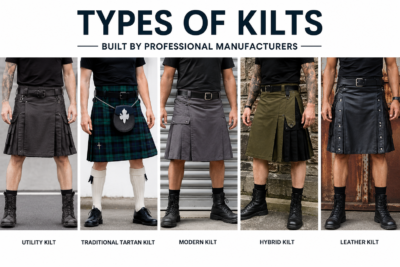
A capable kilt manufacturer produces several distinct kilt categories, each serving a different buyer and price point.
| Kilt Type | Primary Fabric | Typical Buyer | Notes |
|---|---|---|---|
| Traditional tartan kilt | 13oz-16oz wool or acrylic | Weddings, highland games, heritage buyers | Formal, pleated to sett or stripe |
| Utility kilt | 100% cotton drill | Everyday wear, workwear, festivals | Highest-volume modern category |
| Hybrid kilt | Cotton drill plus tartan panels | Fashion-forward buyers | Blends traditional and modern |
| Cargo kilt | Heavyweight cotton | Workwear, outdoor | Multiple utility pockets |
| Leather kilt | Cowhide or buffalo leather | Fashion, cosplay, statement wear | Premium price point |
| Denim kilt | Denim | Casual, streetwear crossover | Growing niche |
| Ladies and kids kilts | Wool, acrylic, cotton | Family and event buyers | Sizing range extension |
The utility kilt is the commercial workhorse. Made from durable cotton drill with cargo pockets and adjustable straps, it drives the majority of kilt sales in the US market and is the easiest entry point for a new highland-wear brand. Traditional tartan kilts carry higher perceived value and suit heritage and formal-event positioning, while leather kilts command the highest margins and tie naturally into Sialkot’s strong leather capability.
Kilt Fabrics and Construction: A Buyer’s Guide
Fabric choice defines a kilt’s price, weight, drape, and market position. Here is what a kilt manufacturer will offer and what each option means for your product.
Wool (13oz to 16oz): The traditional choice for tartan kilts. 13oz suits lighter formal wear, while 16oz is the heavyweight standard for durability and proper pleat structure. Wool carries the highest authenticity and the highest cost.
Acrylic wool blends and poly-viscose: Affordable alternatives to pure wool for tartan kilts. They hold color well, resist wrinkles, cost significantly less, and open a lower retail price point. Ideal for volume and casual-market brands.
Cotton drill (heavy cotton twill): The standard for utility and cargo kilts. Durable, breathable, and available in many colors. This is the fabric behind most modern everyday kilts.
Leather (cowhide, buffalo): Used for premium and statement kilts. Weight and finish vary. Sialkot’s integrated leather supply chain makes this category cost-effective to produce there.
Construction quality separates a kilt that lasts from one that fails. Key markers include proper knife or box pleating stitched to hold shape, reinforced stitching at stress points, quality buckle and strap hardware, and clean interior finishing. When you request samples, these are the details to inspect. Our guide on how clothing manufacturers work explains where in the process each quality checkpoint sits.
Kilt Minimum Order Quantities (MOQ Data)
One thing almost no kilt supplier publishes openly is minimum order quantity. Here are realistic 2026 benchmarks for custom B2B kilt production.
| Kilt Type | Typical MOQ per Style | Notes |
|---|---|---|
| Utility kilt (cotton drill) | 20-50 pieces | Lowest MOQ, simple construction |
| Tartan kilt (acrylic) | 20-50 pieces | Stock tartan keeps MOQ low |
| Tartan kilt (custom wool sett) | 50-100 pieces | Custom weave raises the minimum |
| Hybrid and cargo kilts | 30-50 pieces | Extra panels and pockets |
| Leather kilt | 20-50 pieces | Material cost high, MOQ moderate |
Sources: Aggregated from Pakistan B2B kilt supplier listings and trade marketplace data (2026). Ranges are typical and vary by manufacturer and customization.
As with all apparel, kilt MOQs are usually set per style and per colorway or tartan. Ordering a utility kilt in black and khaki is two minimums, not one. Custom-woven tartan carries its own fabric mill minimum on top of the garment minimum. For the full logic of how minimums scale with complexity and colorway, see our study on MOQ by garment type.
At Wears For You, we produce custom kilts from a minimum of 30 pieces per style with flexibility for new brands, which suits startups testing a first highland-wear range without committing to large inventory. That figure is our own; the benchmark ranges above are drawn from across the market.
Private Label Kilts: Selling Under Your Own Brand
If your goal is to build a kilt or highland-wear brand rather than resell someone else’s product, private label production is the path. A private label kilt manufacturer produces kilts to your specification and applies your branding, so the finished product carries your label, your woven tags, and your packaging.
The private label route works like this. You choose the kilt type, fabric, and colorways. The manufacturer develops a sample to your specification. You approve the sample. The manufacturer produces your run with your branding applied. You receive retail-ready product to sell as your own.
This is how most successful kilt brands operate, including many that present as US or UK companies while producing in Sialkot. Starting with private label at a low minimum lets you launch a highland-wear brand for a fraction of the cost of building a factory relationship from scratch. If you are new to apparel sourcing, our guide to the best approach for startups covers how to begin.
The 10-Point Kilt Supplier Vetting Checklist (Original Framework)
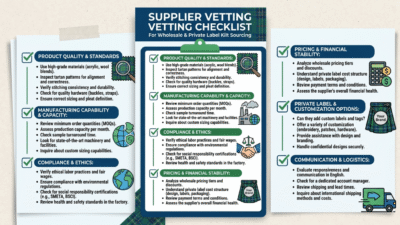
Sourcing kilts overseas carries real risk: quality failures, communication breakdowns, and the occasional outright scam. Use this checklist to vet any kilt manufacturer before you place an order.
- Do they manufacture or just resell? Confirm they physically produce kilts rather than drop-shipping from another workshop.
- Will they send a pre-production sample? Never place a bulk order without approving a physical sample first.
- Is their MOQ transparent? A supplier who dodges the minimum-order question is a warning sign.
- Can they show past production? Ask for photos or references from brands they have produced for.
- How do they communicate? Fast, clear responses, ideally over WhatsApp, predict a smooth production run.
- Do they hold certifications? BSCI, SEDEX, or ISO certification signals audited, ethical production.
- What are their fabric options? A real manufacturer offers wool, acrylic, cotton drill, and leather, not one generic cloth.
- What is the lead time? Get sampling and bulk production timelines separately and in writing.
- What are the payment terms? Reasonable deposit structures and secure payment methods protect you.
- Can they handle your branding? For private label, confirm they apply woven labels, tags, and packaging.
A supplier who passes all ten points is a supplier you can build a business on. This checklist is an original framework you are free to reference; a manufacturer worth working with will welcome every question on it.
How to Choose the Right Kilt Manufacturer for Your Business
Matching the manufacturer to your stage is the final step. If you are a startup, prioritize low MOQs, sample-first production, and clear communication over the lowest unit price. If you are an established retailer, prioritize consistency, reorder reliability, and fabric range. If you are building a premium brand, prioritize construction quality, wool and leather capability, and finishing detail.
Across all three, the strongest position is sourcing directly from the Sialkot hub rather than through a Western reseller, because it shortens your supply chain and protects your margin. A manufacturer that offers low minimums, a genuine fabric range, in-house decoration, and direct communication covers the needs of most kilt buyers. When you are ready to compare a specific quote, our guide on how much it costs to make a clothing brand helps you evaluate whether the numbers work.
Frequently Asked Questions About Kilt Manufacturers
Where are most kilts manufactured?
Most of the world’s kilts are manufactured in Sialkot, Pakistan, which has become the global hub for highland-wear production. This includes traditional tartan kilts, modern utility kilts, and leather kilts. Many kilt brands that present as US, UK, or Canadian companies actually source their production from Sialkot manufacturers, because the city offers a century of export manufacturing heritage, skilled stitching labor, and integrated access to cotton drill, wool, tartan, and leather. Kilts are also made in Scotland at a premium price point, primarily for the heritage and luxury market.
What is the minimum order quantity for custom kilts?
Custom kilt minimum order quantities typically range from 20 to 50 pieces per style for B2B production, though some manufacturers accept lower. Utility kilts and stock-tartan kilts carry the lowest minimums because of simpler construction and readily available fabric. Custom-woven wool tartan carries a higher minimum, often 50 to 100 pieces, because the fabric mill imposes its own minimum yardage. Minimums are usually set per style and per colorway, so ordering one design in two colors counts as two minimums.
How much does it cost to manufacture a kilt?
Kilt manufacturing cost depends on type, fabric, and order volume. Utility kilts in cotton drill are the most affordable, with typical factory prices ranging from roughly $20 to $30 per piece at wholesale volumes. Tartan kilts vary widely based on whether they use acrylic or pure wool, with wool commanding a significant premium. Leather kilts sit at the highest price point due to material cost. As with all apparel, per-unit cost falls as order quantity rises, though low minimums reduce your overall inventory risk when testing a new market.
Can I start a kilt brand with my own label?
Yes. Private label kilt manufacturing lets you sell kilts under your own brand. You choose the kilt type, fabric, and colorways, the manufacturer produces to your specification and applies your woven labels, tags, and packaging, and you receive retail-ready product to sell as your own. Many successful highland-wear brands operate this way, launching with a low-minimum private label run rather than building factory infrastructure. Starting with a manufacturer that offers minimums as low as 30 pieces makes launching a kilt brand accessible to startups.
What fabric are kilts made from?
Kilts are made from several fabrics depending on type. Traditional tartan kilts use 13oz to 16oz wool, or more affordable acrylic and poly-viscose blends. Utility and cargo kilts use heavy cotton drill, a durable cotton twill. Premium and statement kilts use leather, typically cowhide or buffalo. Wool carries the highest authenticity and cost, acrylic blends open a lower price point, cotton drill dominates the modern everyday market, and leather commands the highest margins.
What is the difference between a utility kilt and a traditional kilt?
A traditional kilt is made from wool or acrylic tartan, pleated to a specific sett or stripe pattern, and worn for formal occasions, weddings, and highland events. A utility kilt is made from durable cotton drill, features cargo pockets and adjustable straps, and is designed for everyday wear, work, and festivals. The utility kilt is a modern adaptation that has become the highest-volume category in Western markets, while the traditional kilt retains its heritage and formal associations. Many manufacturers produce both, along with hybrid kilts that combine cotton construction with tartan panels.
How do I know if a kilt manufacturer is legitimate?
Vet a kilt manufacturer on several factors before ordering. Confirm they physically manufacture rather than resell, request a pre-production sample before any bulk order, check that their minimum order quantity is transparent, ask to see past production or brand references, and evaluate how quickly and clearly they communicate. Certifications such as BSCI, SEDEX, or ISO indicate audited, ethical production. Secure payment terms and a reasonable deposit structure also protect you. A supplier who welcomes these questions and answers them clearly is far more likely to be reliable than one who avoids them.
Can kilt manufacturers produce custom tartan designs?
Yes. A capable kilt manufacturer can produce any registered tartan pattern accurately in fabric, and can also weave custom tartan designs to your specification. Official clan tartans are recorded in the Scottish Register of Tartans, and a manufacturer can reproduce these patterns faithfully. For brands wanting a unique identity, a custom tartan sett can be designed and woven, though custom weaving carries its own fabric minimum. The heritage and clan associations of traditional tartans remain Scottish regardless of where the cloth is woven.
Sources and Methodology
Information in this guide is compiled from the following sources:
- Scottish Register of Tartans, official tartan authority
- Pakistan B2B kilt manufacturer and exporter listings, TradeKey and Lookup.pk (2026)
- Published wholesale and custom kilt supplier data from Sialkot manufacturers (2026)
- Wears For You first-party manufacturing capability (Sialkot, Pakistan)
Methodology note: MOQ and pricing ranges are aggregated from Pakistan B2B kilt supplier listings and trade marketplace data, and represent typical ranges rather than measured averages. Wears For You’s own 30-piece minimum is first-party data, disclosed as such. Kilt type and fabric information reflects standard highland-wear manufacturing practice.
Whether you are stocking a boutique, launching a highland-wear brand, or adding kilts to an established range, the right kilt manufacturer makes the difference between a product that sells and one that sits. At Wears For You, we manufacture custom kilts from our facility in Sialkot, Pakistan, the global home of highland-wear production, with a minimum of 30 pieces per style, flexible options for new brands, in-house decoration, and direct WhatsApp communication. For a quote on your specific kilt type, fabric, and quantity, contact us or message us on WhatsApp and we will scope your run with you.