How to Communicate With a Clothing Manufacturer in 2026
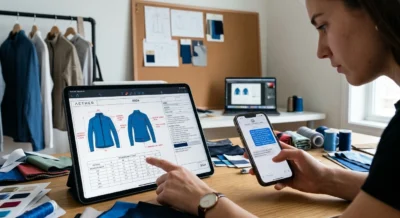
Learning how to communicate with a clothing manufacturer clearly is the difference between receiving the product you designed and receiving something close but wrong. Most production problems, wrong fabric, off measurements, missed details, delayed shipments, do not come from bad factories. They come from a communication gap between what the brand meant and what the manufacturer understood.
Here is the part almost nobody tells you: that gap is a two-way street. Yes, you need to send clear specifications. But the manufacturer also needs to be responsive, direct, and willing to ask questions rather than guess. Fix both sides and production runs smoothly. Fix only one and you are still exposed.
This guide covers what causes the communication gap, exactly how to close it from your side, how to choose a manufacturer who closes it from theirs, and what a miscommunication actually costs when it slips through.
Key points at a glance:
- Most production errors come from miscommunication, not manufacturer incompetence
- A complete tech pack removes interpretation and is the single most important tool
- The gap is two-way: clear specs from you, plus a responsive manufacturer
- A single miscommunication can cost $100 to $500 per resample round, plus weeks of delay
- Written confirmation and an approved golden sample prevent most bulk-production disasters
- Choosing a direct, responsive manufacturer matters as much as sending good documents
What Is the Communication Gap in Clothing Manufacturing?
The communication gap in clothing manufacturing is the difference between what a brand intends and what the manufacturer actually produces, caused by unclear specifications, assumptions, language differences, or slow and indirect communication. It is the root cause behind most sampling errors, production delays, and quality disputes.
The gap exists because a manufacturer producing your garment has never met you and has no context for your brand. As one industry guide notes, overseas factories produce hundreds of styles for dozens of clients at once, so without complete documentation your order gets interpreted by a pattern-maker who is guessing at your intent. Every guess is a chance for the finished product to drift from what you pictured.
Understanding how clothing manufacturers work helps here, because the gap opens at specific, predictable points in the process, which means it can be closed at those same points.
The 5 Layers of the Communication Gap (Original Framework)
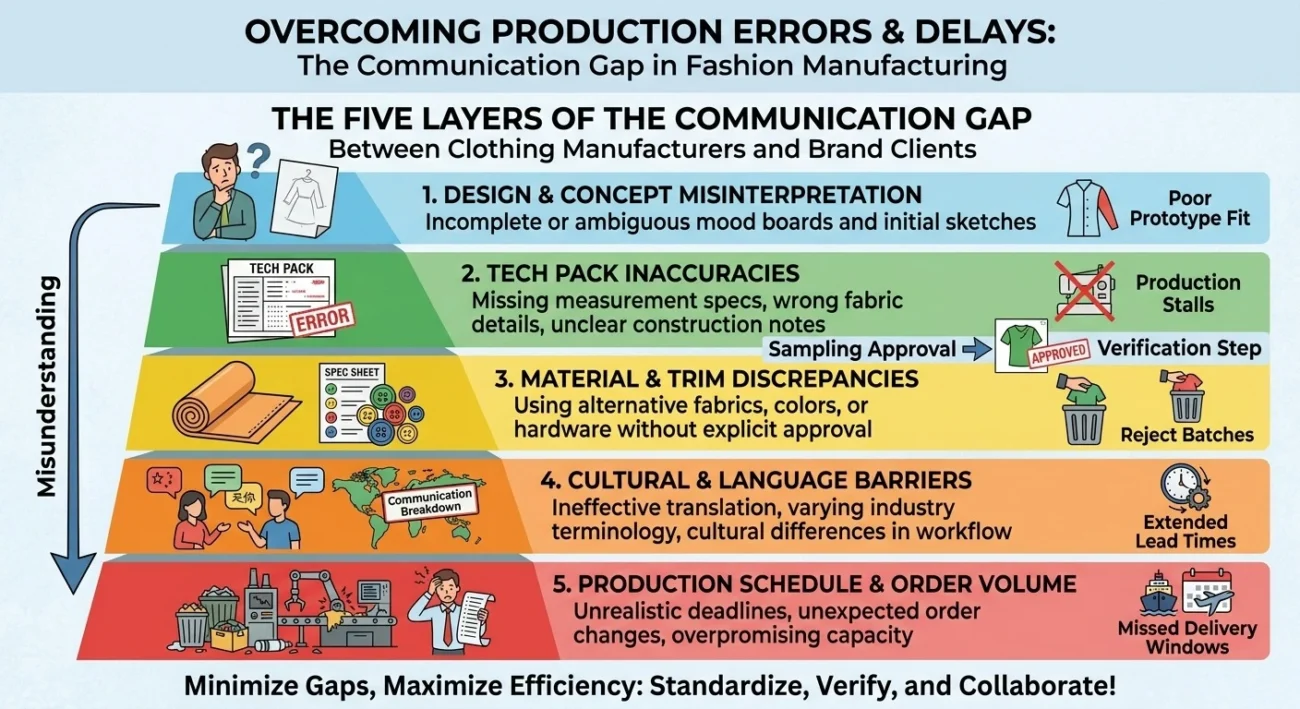
Communication breakdowns are not random. They happen at five specific layers. Close each one and the gap disappears.
Layer 1: The Specification Gap. What you want versus what you documented. If your tech pack is vague or missing measurements, the factory fills the blanks with its own defaults. This is the most common and most preventable layer.
Layer 2: The Language Gap. Even when a factory speaks English, garment manufacturing runs on a universal technical language of flat sketches, measurement tables, and bills of materials. Words get lost; technical drawings do not.
Layer 3: The Assumption Gap. What you think is “obvious” versus what actually needs stating. You may assume a standard seam or a specific fit; the factory has no way to know unless you specify it.
Layer 4: The Responsiveness Gap. How fast and how directly the manufacturer replies. A factory that takes days to answer, or routes everything through a sales middleman, multiplies every other gap because problems surface too late to fix cheaply.
Layer 5: The Confirmation Gap. What was agreed versus what was recorded. Verbal or scattered agreements get forgotten. Without one written record and an approved sample, bulk production proceeds on memory.
This framework is an original tool you can use to diagnose exactly where a relationship is breaking down. Most founders obsess over Layer 1 and ignore Layers 4 and 5, which is why problems still slip through even with a good tech pack.
How to Communicate With a Clothing Manufacturer: Your Side
You control four of the five layers directly. Here is how to close them.
Send a Complete Tech Pack
A tech pack is a technical document that gives the manufacturer everything needed to produce your garment accurately: flat sketches, a measurement table with tolerances, a bill of materials, construction details, colorways, and labeling. It removes interpretation from the equation. Sending a mockup image or a reference photo alone is the single most common mistake, because a photo shows the idea but none of the measurable instructions a factory needs.
Set Measurement Tolerances
For every point of measurement, set a small allowed margin of error. This tells the factory exactly how precise each dimension must be and gives you a clear standard for inspection. Without tolerances, “close enough” is decided by the factory, not you.
Confirm Everything in Writing
After any call or chat, summarize what was agreed in a written message. One shared record of approved measurements, colors, trims, and workmanship prevents the disputes that arise when sampling moves to bulk. If it is not written, it did not happen.
Approve a Golden Sample
Never authorize bulk production without approving a physical pre-production sample first. Sign off on it, and treat it as the master reference for all quality checks. The approved sample is the clearest communication tool you have, because it is the actual product, not a description of it. Skipping this step is where the most expensive mistakes happen.
The Other Half: Choosing a Manufacturer Who Communicates
Here is what the other guides leave out. You can send a flawless tech pack and still hit a wall if your manufacturer is slow, evasive, or buffered behind a sales middleman. Layer 4, responsiveness, is theirs to close, not yours, and you decide it when you choose the factory.
When you are still selecting a manufacturer, test communication before you order. Message them a real question and see how fast and how clearly they reply. A factory that answers within hours, in plain language, and asks clarifying questions back is showing you exactly how the production run will go. One that takes days, gives vague answers, or routes you through layers of sales staff is showing you that too.
Direct contact matters enormously. When you can message the factory itself, ideally over a channel like WhatsApp, problems get solved in minutes. When every message passes through a middleman who relays it to the factory and back, small issues take days and meaning gets lost at each handoff. This is why we built Wears For You around direct WhatsApp communication between the brand and our factory, with a sample-first process so nothing reaches bulk production without your written approval. It is also why our guide to the best manufacturers for startups puts communication responsiveness among the top selection criteria, above headline unit price.
What a Communication Failure Actually Costs
Miscommunication is not just frustrating; it is expensive. Here is what a single breakdown costs.
Each additional sample round to correct an error typically costs $150 to $500 in production and shipping, according to industry estimates, and correcting a poorly briefed garment often takes two to four rounds. That is up to $2,000 and several weeks gone before bulk even starts. If the error is not caught until bulk production, the cost multiplies into an entire run of unsellable stock.
Then there is time. Every resample round adds one to three weeks. A launch timed to a season can miss its window entirely because of a measurement that was never specified. For the full picture of how these costs stack into a launch budget, see our clothing brand startup costs study. The takeaway is simple: the few hours spent closing the communication gap upfront are the cheapest insurance in the entire production process.
A Simple Communication Routine That Prevents Problems
You do not need a complicated system. A light, consistent routine closes most of the gap.
Brief every project with a complete tech pack and reference images. Set a regular check-in rhythm, whether weekly messages or scheduled updates, so issues surface early. Confirm each decision in writing in the same thread so there is one record. Approve a golden sample before bulk, every time. And when problems arise, send clear feedback with photos rather than vague complaints, because a photo of the defect closes the language gap instantly. Manufacturers who treat you as a long-term partner will welcome this rhythm, and the ones who resist it are telling you something useful.
Frequently Asked Questions
How do you communicate with a clothing manufacturer?
Communicate with a clothing manufacturer primarily through a complete tech pack, which is a technical document containing flat sketches, a measurement table with tolerances, a bill of materials, construction details, and colorways. Supplement it with reference images, confirm all decisions in writing, and approve a physical pre-production sample before bulk production. For ongoing communication, a direct channel like WhatsApp with the factory itself, rather than a sales middleman, resolves issues fastest. The clearer and more documented your communication, the fewer errors reach the finished product.
Why do clothing manufacturers make mistakes?
Clothing manufacturers usually make mistakes because of a communication gap, not incompetence. A factory produces hundreds of styles for many clients and has no context for your brand, so when your specifications are vague or incomplete, its pattern-makers fill the gaps with their own default fabrics, patterns, and construction. The result is a sample with the wrong fabric weight, incorrect fit, or missing details. Most of these errors are preventable with a complete tech pack, written confirmation, and an approved sample before bulk production.
What is the biggest cause of production errors in clothing manufacturing?
The biggest cause is incomplete or unclear specifications, usually a missing or vague tech pack. When a factory does not receive measurable instructions, it interprets your design using its own standards, which rarely match your intent. The second biggest cause is skipping the pre-production sample approval, which lets errors reach bulk production undetected. Both are communication failures rather than manufacturing failures, and both are preventable.
How do I overcome the language barrier with an overseas manufacturer?
Overcome the language barrier by communicating in the universal technical language of garment manufacturing: flat sketches, measurement tables, bills of materials, and reference images rather than long written descriptions. These technical documents mean the same thing in every country. Confirm decisions in writing to create a shared record, use photos to illustrate any issues, and choose a manufacturer that responds clearly and asks questions. Technical drawings and approved samples communicate far more reliably than words across a language gap.
How much does a sampling mistake cost?
Each additional sample round to correct a mistake typically costs $150 to $500 in production and shipping, and a poorly briefed garment often needs two to four rounds, which can total up to $2,000 and several weeks before bulk production begins. If the error is not caught until bulk, the cost escalates to an entire production run of unsellable inventory. This is why investing time in clear communication and a proper golden sample approval is far cheaper than fixing errors later.
How can I tell if a manufacturer communicates well before ordering?
Test their communication before you place an order. Send a specific question about your product and measure how quickly and clearly they respond. A good manufacturer replies promptly, in plain language, and asks clarifying questions back, which shows they are engaging with your project rather than guessing. Warning signs include slow replies, vague answers, and being routed through multiple layers of sales staff who relay messages to the factory. How they communicate before you pay is a reliable preview of how the production run will go.
Should I use WhatsApp to communicate with my clothing manufacturer?
Yes, a direct messaging channel like WhatsApp is one of the most effective ways to communicate with a clothing manufacturer, because it enables fast, direct contact with the factory and easy sharing of photos and documents. The key advantage is directness: messaging the factory itself resolves issues in minutes, whereas communication routed through a middleman takes longer and loses meaning at each handoff. Always pair quick messaging with written confirmation of important decisions so there is a clear record.
Sources and Methodology
Information in this guide is compiled from the following sources:
- Techpacker, problems in clothing manufacturing and how to avoid them
- Sigraphics, how to communicate with clothing manufacturers (2026)
- Modaknits, how to work with a clothing manufacturer (2025)
- Fashion Insiders, challenges working with overseas manufacturers
- Wears For You first-party production and communication practice (Sialkot, Pakistan)
Methodology note: Resample cost figures reflect published industry estimates and vary by product and factory. The 5 Layers of the Communication Gap is an original framework built for this guide. Wears For You’s direct-communication practice is disclosed as first-party.
Clear communication is the cheapest insurance in clothing manufacturing, and it depends as much on choosing a responsive manufacturer as on sending good specifications. At Wears For You, we manufacture custom apparel from Sialkot, Pakistan with direct WhatsApp communication between you and our factory, a sample-first process, and written confirmation at every step, so nothing gets lost between what you designed and what we deliver. To start a project with a manufacturer built around clear communication, contact us or message us on WhatsApp.