MOQ by garment type in 2026 ranges from roughly 30 units for simple knit basics to 3,000 units for high-volume factory programs, with most manufacturers setting minimums between 50 and 300 pieces per style. The spread is enormous, and where your product lands depends on three things: how complex the garment is to construct, which country you produce in, and what decoration you apply.
This study compiles benchmark minimums across garment categories and manufacturing countries, quantifies how decoration and fabric choices push those minimums up, and introduces a scoring system you can use to estimate the MOQ for any garment before you contact a single factory.
Key findings at a glance:
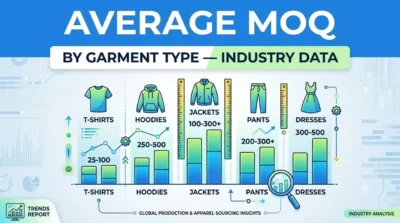
- Simple knits like t-shirts carry the lowest minimums, typically 50 to 100 units per style
- Structured outerwear and denim carry the highest, typically 200 to 500 units per style
- Adding embroidery or custom trims can push a hoodie from 100 units to 250 or more (Argus Apparel)
- MOQ spans roughly 60x between the lowest and highest sourcing countries (OneAim Apparel, 2026)
- Portugal and Italy sit lowest at 30 to 100 units; Cambodia and Bangladesh run 500 to 3,000
- MOQs are almost always set per style, per colorway, which multiplies your real minimum
What MOQ Means and Why Factories Set It
MOQ stands for minimum order quantity. It is the smallest number of units a factory will produce in a single run for one style. Minimums exist because factories carry fixed setup costs before the first garment is sewn: sourcing fabric rolls, cutting markers, programming machines, and scheduling a production line. Those costs are identical whether you order 30 units or 3,000, which is why small runs cost more per unit and why many factories decline them outright.
The critical detail most founders miss is that MOQ is usually set per style, per colorway. Ordering one t-shirt design in black and white at a 100-unit minimum is not a 100-unit order. It is two separate minimums totaling 200 units. We cover the full multiplication math in our clothing brand startup costs study, where MOQ is identified as the single largest controllable cost lever in a launch budget.
MOQ by Garment Type: Benchmark Data
Here are aggregated 2026 benchmark minimums by garment category. Ranges reflect typical mid-tier manufacturers and will vary by factory, fabric, and order history.
| Garment Type | Typical MOQ per Style | Complexity | Notes |
|---|---|---|---|
| T-shirts (basic knit) | 50-100 units | Low | Fewest pattern pieces, fastest sew time |
| Leggings | 50-100 units | Low | Simple construction, stretch knit |
| Tank tops and vests | 50-100 units | Low | Minimal panels |
| Polo shirts | 100-150 units | Low-Medium | Collar and placket add steps |
| Sweatshirts | 100-200 units | Medium | Heavier fabric, more panels |
| Hoodies | 100-200 units | Medium | Hood, drawcord, pocket construction |
| Joggers and sweatpants | 100-200 units | Medium | Elastic, cuffs, waistband |
| Shorts (woven) | 100-200 units | Medium | Waistband and closure hardware |
| Shirts (woven button-up) | 150-250 units | Medium-High | Collar, cuffs, placket, buttons |
| Jackets (unlined) | 200-300 units | High | Multiple panels, zips, topstitching |
| Denim and jeans | 200-400 units | High | Heavy fabric, hardware, wash process |
| Structured outerwear | 300-500 units | Very High | Lining, insulation, bonded seams |
| Blazers and tailoring | 300-500 units | Very High | Interfacing, canvas, precision fit |
Sources: Aggregated from Mingxing Clothing, Argus Apparel, Specter OS, and AKCN published 2026 benchmarks, cross-referenced for consistency. Figures are typical ranges, not measured averages.
The pattern is consistent. Every additional construction step, panel, layer of lining, or piece of hardware adds setup time and coordination, which factories offset with higher minimums. This is why brands are routinely advised to launch with simple knits and expand into complex silhouettes once demand is proven.
If you are producing hoodies specifically, our best hoodie manufacturers guide covers minimums alongside fabric weight and GSM options in more detail.
The MOQ Complexity Index (Original Framework)
Benchmark tables for MOQ by garment type only help if your garment is on the list. This index lets you estimate the minimum for any garment by scoring its construction.
Score your garment on five factors, 1 point each:
- Panels: Does it have more than six pattern pieces?
- Hardware: Does it use zips, snaps, rivets, or buttons?
- Layers: Is it lined, insulated, or bonded?
- Specialty processes: Does it need washing, dyeing, or garment finishing?
- Precision fit: Does it require interfacing, canvas, or structured tailoring?
Then read your estimated MOQ tier:
| Score | Tier | Estimated MOQ | Example Garments |
|---|---|---|---|
| 0 points | Tier 1, Simple | 30-100 units | T-shirts, leggings, tanks |
| 1 point | Tier 2, Basic Plus | 100-150 units | Polos, sweatshirts, hoodies |
| 2 points | Tier 3, Moderate | 150-250 units | Woven shirts, shorts, joggers |
| 3 points | Tier 4, Complex | 250-400 units | Jackets, denim, cargo trousers |
| 4-5 points | Tier 5, Highly Complex | 400-600+ units | Outerwear, blazers, technical shells |
How to use it: Score your garment before your first factory conversation. If your score lands in Tier 4 or 5 and you are a new brand, that is a signal to either simplify the design for your first run or budget significantly more capital. Many first-time founders design a Tier 5 garment and then discover the minimum is ten times what they planned for.
This index is an original model built for this study from aggregated benchmark data. Treat it as a planning estimate, not a quote.
MOQ by Garment Type vs Country: Where Minimums Are Lowest
Your sourcing country changes your minimum as much as your garment does. MOQ spans roughly 60x between the lowest and highest sourcing destinations, according to OneAim Apparel’s 2026 sourcing analysis.
| Country | Typical MOQ per Style | Strengths | Trade-offs |
|---|---|---|---|
| USA | 10-100 units | Fastest turnaround, no import duty | Highest per-unit cost |
| Portugal / Italy | 30-100 units | Premium quality, EU duty-free | High cost, EU-focused |
| Pakistan | 50-200 units | Low minimums with certified factories | Longer shipping to US/EU |
| Turkey | 50-300 units | 7-15 day EU delivery | Mid-tier pricing |
| India | 50-1,000 units | Strong knits and embroidery | Wide variability by region |
| China | 500-5,000+ units | Scale, materials, technique range | High minimums, US tariff exposure |
| Vietnam | 500-1,500 units | Complex garments, rising quality | Port congestion, long lead times |
| Bangladesh | 500-3,000 units | Lowest unit cost on basics | Very high minimums |
| Cambodia | 1,000-3,000 units | Basic apparel at volume | Smallest factory base |
Sources: Apex Fashion Lab MOQ data (2026), Cosmo Sourcing country guide (2026), Portugal Clothing Factory, Thygesen Apparel. Ranges are typical, not universal.
The Certification Gap Worth Knowing About
One finding rarely reported in MOQ guides: independent sourcing analysis notes that Pakistan’s Sialkot cluster has among the highest densities of BSCI-certified factories at the mid-size tier in Asia, meaning brands can access independently audited ethical supply chains at 50-unit minimums. In China or Bangladesh, that same certification level typically only becomes available at 500-plus unit tiers.
For brands that need to evidence ethical sourcing to retail buyers or investors while still ordering small, that combination is structurally unusual. Our overview of manufacturing in Sialkot covers the cluster in more detail, and our apparel manufacturing industry statistics study puts the country data in wider context.
Disclosure: Wears For You operates in this cluster and produces at a minimum of 30 pieces per style, with flexibility for new brands. That is our own figure, not an industry average. The country benchmarks above are drawn from independent sources.
How Decoration Raises Your MOQ
Decoration methods carry their own setup costs, and each one raises the minimum independently of the garment itself. This is the layer that most often breaks a founder’s MOQ by garment type estimate.
| Decoration Method | Typical MOQ Impact | Why |
|---|---|---|
| Screen printing | +50 to 100 units | Screen setup cost per color |
| Embroidery | +100 to 150 units | Digitizing and machine setup |
| Sublimation | +50 to 100 units | Print run and transfer setup |
| DTG printing | Minimal | No setup, prints on demand |
| Heat press vinyl | Minimal | Low setup, cut per piece |
| 3D puff print | +100 units | Specialty screen and cure setup |
| Custom woven labels | +200 to 500 units | Label mills carry their own minimums |
| Custom hardware | +300 to 500 units | Tooling and mold costs |
Sources: Aggregated from Argus Apparel, Specter OS, and manufacturer disclosures (2026). Estimates.
Real example from published industry data: a plain hoodie produced at a 100-piece minimum can require 250 or more once embroidery and custom trims are added. That is a 150% jump driven entirely by decoration, not by the garment.
Practical takeaway: For a first run, DTG and heat press keep your minimum lowest. Save embroidery and custom hardware for a second run once the design is proven.
Fabric Is a Separate Minimum
Your factory minimum and your fabric minimum are two different numbers, a distinction almost every guide to MOQ by garment type misses. Stock fabric the factory already holds keeps your minimum low. Custom colors or custom-knitted fabric trigger the mill’s own MOQ, commonly 200 to 500 meters or more, which forces the factory to raise yours. Use stock fabrics for a first run, and pick one fabric that works across several styles so a single cotton blend can cover tees, hoodies, and joggers against one mill minimum.
Calculating Your True Minimum
Your real order size is rarely the number the factory quotes. Use this formula:
True minimum = MOQ per style x number of colorways x number of styles
| Scenario | Factory MOQ | Colorways | Styles | True Minimum |
|---|---|---|---|---|
| Testing one design | 50 | 1 | 1 | 50 units |
| One design, two colors | 100 | 2 | 1 | 200 units |
| Small capsule | 100 | 2 | 3 | 600 units |
| Full collection | 200 | 3 | 5 | 3,000 units |
Size runs matter too. A 100-unit minimum across five sizes gives you roughly 20 pieces per size. If your size curve is uneven, and most are, you may sell through mediums while smalls and double-XLs sit as dead stock. Ask whether the minimum applies per style or per size, and request a weighted size curve rather than an even split. Our guide on how much it costs to make a clothing brand walks through budgeting around these numbers.
How to Negotiate a Lower MOQ by Garment Type
Minimums are more flexible than they appear, particularly for brands that signal reliability. Whatever your MOQ by garment type benchmark suggests, these six moves can lower it:
Simplify the garment. Removing a lining, swapping hardware for a pull-on design, or cutting a panel can move you down a full complexity tier.
Use stock fabric. This removes the mill minimum from your equation entirely.
Reduce colorways before reducing units. One color at 100 units is far easier to place than two colors at 50 each.
Commit to a reorder schedule. Factories accommodate brands that demonstrate ongoing volume. Sharing a realistic growth plan often unlocks flexibility a cold enquiry will not.
Bring a complete tech pack. Factories quote conservatively when specifications are vague. Clear documentation reduces their risk and their minimum.
Start with private label. Adapting an existing block pattern carries a lower minimum than developing one from scratch. Our guide to the best clothing manufacturers for startups covers which partners actually accommodate small runs, and how clothing manufacturers work explains where sampling fits before bulk.
Frequently Asked Questions About MOQ by Garment Type
What is the average MOQ for clothing manufacturing?
The average MOQ in clothing manufacturing sits between 50 and 300 units per style for most mid-tier manufacturers, though the full range spans roughly 30 units to 3,000 units. Simple knit garments like t-shirts and leggings typically start at 50 to 100 units. Structured items like jackets and denim usually start at 200 to 400 units. Country matters as much as garment type: minimums in Portugal and the USA can start at 30 units, while Bangladesh and Cambodia commonly require 500 to 3,000 units per style.
What is the MOQ for hoodies?
Hoodie MOQs typically range from 100 to 200 units per style at mid-tier manufacturers, driven by the hood construction, drawcord, pocket, and heavier fabric. That minimum rises significantly with decoration. Published industry data shows a plain hoodie produced at a 100-piece minimum can require 250 or more once embroidery and custom trims are added. Some low-minimum manufacturers, particularly in Portugal, the USA, and Pakistan, produce hoodies at 30 to 100 units per style.
Which country has the lowest MOQ for clothing?
The USA and Portugal generally offer the lowest minimums, commonly 10 to 100 units per style, followed by Pakistan and Turkey at 50 to 300 units. China, Vietnam, Bangladesh, and Cambodia sit at the high end, typically 500 to 3,000 units. The trade-off is cost and capability: USA and European production carries the highest per-unit price, while high-minimum countries offer the lowest unit cost at volume. For a first production run, low minimums usually matter more than low unit price, because unsold inventory costs more than the per-unit difference.
Does MOQ apply per style or per colorway?
MOQ is almost always set per style and per colorway. A 100-unit minimum on a t-shirt design produced in black and white means two separate minimums totaling 200 units, not 100. Some factories also apply constraints to the size run within that minimum. This multiplication is the most common reason first-time founders end up with far larger orders than they planned. Always confirm in writing whether the quoted minimum applies per style, per colorway, or per size.
Does embroidery increase MOQ?
Yes. Embroidery typically adds 100 to 150 units to a minimum because of digitizing and machine setup costs. Screen printing adds roughly 50 to 100 units per color due to screen setup. Custom woven labels can add 200 to 500 units because label mills carry their own minimums, and custom hardware can add 300 to 500 because of tooling costs. DTG printing and heat press vinyl have minimal MOQ impact since they require little setup, making them the better choice for a first low-volume run.
Can I get a clothing manufacturer to produce under 50 units?
Yes, though options narrow considerably. Manufacturers in the USA, Portugal, and Pakistan produce at 25 to 50 units per style, and some accept 30. Below that threshold you are generally looking at print-on-demand, blanks with applied decoration, or a local sewing studio rather than a full-package factory. Expect to pay 30 to 50 percent more per piece than at 500 units, since fixed setup costs spread across fewer garments. That premium is usually worth it: ordering 500 units of an unvalidated design ties up far more capital, and unsold inventory is a total loss rather than a margin difference.
Sources and Methodology
Data in this study is compiled from the following sources:
- Apex Fashion Lab, MOQ by Country and Cost Data (2026)
- Cosmo Sourcing, Top Countries for Apparel Manufacturing (2026)
- OneAim Apparel, Where to Manufacture Clothing (2026)
- Specter OS, MOQ in Clothing Manufacturing (2026)
- Argus Apparel, MOQ in Clothing Manufacturing (2026)
- Mingxing Clothing, MOQ garment benchmarks (2025-2026)
- AKCN / Clothing Producer, low MOQ cost analysis (2026)
- Maker’s Row, Low MOQ USA manufacturers (2026)
- Thygesen Apparel, cut and sew manufacturer MOQ data (2026)
- Portugal Clothing Factory, EU vs Asia MOQ comparison (2026)
Methodology note: Garment-type and country MOQ ranges are aggregated from multiple published manufacturer and sourcing-consultant disclosures, then cross-referenced for consistency. They represent typical ranges at mid-tier manufacturers, not measured averages from a survey. The MOQ Complexity Index is an original planning model built for this study from those inputs and should be treated as an estimate rather than a quote. Wears For You’s own 30-piece minimum is first-party data and is disclosed as such rather than presented as an industry benchmark.
Understanding MOQ by garment type is the difference between a first production run you can sell through and one that becomes dead stock. At Wears For You, we manufacture custom apparel from our facility in Sialkot, Pakistan at a minimum of 30 pieces per style, with flexibility for new brands still testing their designs, sample-first production, and direct WhatsApp communication with the factory. If you want a real minimum and quote for your specific garment rather than a benchmark range, contact us or message us on WhatsApp and we will scope it with you.