The global apparel manufacturing industry is valued at $507.9 billion in 2026, according to IBISWorld, with 459,000 businesses operating worldwide. That number represents one of the largest manufacturing sectors on the planet, employing tens of millions of workers across more than 150 countries and producing over 100 billion garments every year.
This article compiles the most current apparel manufacturing statistics for 2026, covering market size, top manufacturing countries, employment data, export figures, sustainability metrics, and industry trends. Whether you are a brand founder choosing a manufacturing partner, an industry analyst, or a researcher, these numbers provide a data-driven view of where the apparel manufacturing industry stands today.
Key statistics at a glance:
- The global apparel manufacturing industry is valued at $507.9 billion in 2026 (IBISWorld)
- The broader apparel market (retail) reached $1.9 trillion in 2026 (Statista)
- Over 100 billion garments are produced globally each year
- The fashion and textile industry employs approximately 430 million people worldwide (Solidarity Center, World Bank)
- China leads global garment exports at $301 billion in 2024
- Pakistan’s textile exports reached $17.85 billion in calendar year 2025
- The apparel industry accounts for approximately 10% of global carbon emissions
Global Apparel Market Size and Manufacturing Value
The apparel manufacturing industry is a subset of the broader apparel market. Understanding the distinction matters:
The apparel manufacturing industry covers the production side of clothing, from raw material processing through cut-and-sew operations to finished garment output. IBISWorld values this sector at $507.9 billion globally in 2026, representing 459,000 businesses that have grown at a CAGR of 2.1% between 2020 and 2025.
The broader apparel market, which includes retail, distribution, and e-commerce, is significantly larger. Here is how the numbers break down:
| Metric | Value | Source |
| Global apparel manufacturing industry value | $507.9 billion (2026) | IBISWorld |
| Global apparel retail market value | $1.9 trillion (2026) | Statista |
| Projected retail market value (2030) | $2.21-$2.61 trillion | Research and Markets, GM Insights |
| Projected retail CAGR (2026-2030) | 2.6%-5.7% | Statista, Fortune Business Insights |
| Asia Pacific market share | 41% of global revenue (2025) | Fortune Business Insights |
| U.S. apparel market value | $373 billion (2026) | Statista |
| Women’s apparel segment | $1 trillion (2026) | Statista |
| Online apparel sales (U.S.) | ~38% of total apparel sales (2025) | Customcy |
| Mass apparel market share | 67.8% of revenue (2025) | Grand View Research |
The market is large and still expanding, driven by rising disposable incomes in Asia Pacific, growth of e-commerce, expansion of direct-to-consumer models, and increasing demand for activewear and athleisure categories. For brand founders considering how much it costs to start a clothing brand, this growth signals continued opportunity, though competition remains intense and most clothing startups still fail.
Top Garment Manufacturing Countries (2026 Rankings)
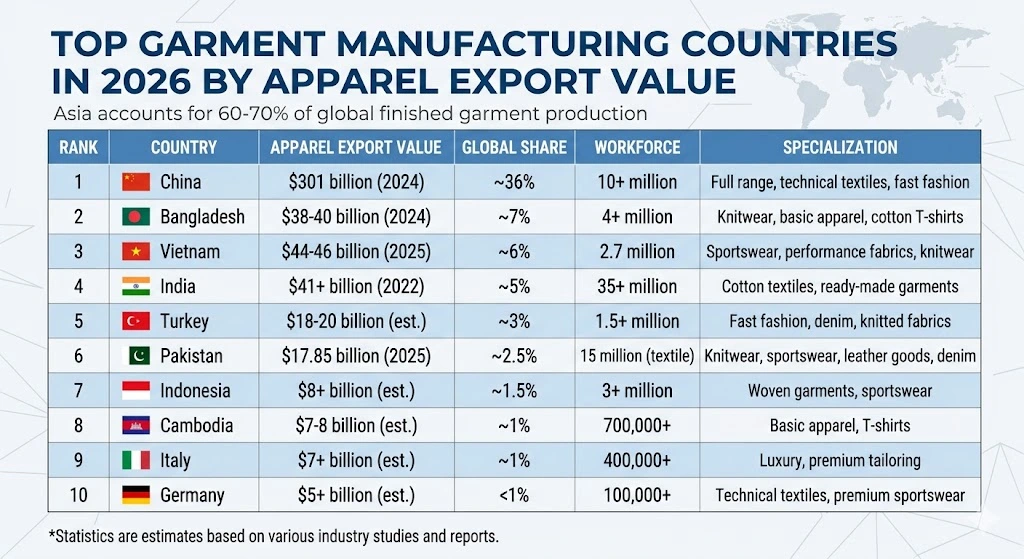
Most of the world’s clothing is manufactured in Asia. China, Bangladesh, Vietnam, India, and Pakistan collectively account for 60-70% of global finished garment production. Here is how the top manufacturing countries rank by export value:
| Rank | Country | Apparel Export Value | Global Share | Workforce | Specialization |
| 1 | China | $301 billion (2024) | ~36% | 10+ million | Full range, technical textiles, fast fashion |
| 2 | Bangladesh | $38-40 billion (2024) | ~7% | 4+ million | Knitwear, basic apparel, cotton T-shirts |
| 3 | Vietnam | $44-46 billion (2025) | ~6% | 2.7 million | Sportswear, performance fabrics, knitwear |
| 4 | India | $41+ billion (2022) | ~5% | 35+ million | Cotton textiles, ready-made garments |
| 5 | Turkey | $18-20 billion (est.) | ~3% | 1.5+ million | Fast fashion, denim, knitted fabrics |
| 6 | Pakistan | $17.85 billion (2025) | ~2.5% | 15 million (textile) | Knitwear, sportswear, leather goods, denim |
| 7 | Indonesia | $8+ billion (est.) | ~1.5% | 3+ million | Woven garments, sportswear |
| 8 | Cambodia | $7-8 billion (est.) | ~1% | 700,000+ | Basic apparel, T-shirts |
| 9 | Italy | $7+ billion (est.) | ~1% | 400,000+ | Luxury, premium tailoring |
| 10 | Germany | $5+ billion (est.) | <1% | 100,000+ | Technical textiles, premium sportswear |
Sources: Textile Today, TradeInt, World Population Review, Pakistan Bureau of Statistics, Cosmo Sourcing. Values marked (est.) are model estimates based on available trade data.
What this means for brand founders: Your choice of manufacturing country directly impacts your cost per unit, lead time, minimum order quantities, and product quality. China offers the broadest capability but rising labor costs and tariffs (effective rates reached ~35% on Chinese apparel imports to the U.S. by late 2025) are pushing many brands to diversify. Bangladesh offers the lowest labor costs but requires high MOQs (typically 1,000-3,000 units). Pakistan and Vietnam offer strong middle-ground options, particularly for sportswear, knitwear, and leather goods, with more flexible minimums.
At Wears For You, we manufacture from Sialkot, Pakistan, a city with over a century of export manufacturing heritage. Sialkot produces over 70% of the world’s hand-stitched footballs, and its integrated supply chain supports sportswear, leather goods, and custom apparel with minimums starting at just 50 units.
Pakistan’s Apparel Manufacturing: Key Statistics
Pakistan is the world’s sixth-largest garment exporter and a rising force in value-added textile manufacturing. For context on the manufacturing landscape Wears For You operates in:
| Metric | Value | Source |
| Total textile exports (Calendar Year 2025) | $17.85 billion | Pakistan Bureau of Statistics |
| Textile exports (Jul-Sep FY2025-26, Q1) | $4.774 billion (+5.6% YoY) | PBS |
| Textile sector contribution to GDP | ~8.5% | Various industry sources |
| Share of manufacturing sector | 46% | Industry data |
| Share of national exports | 60%+ | PBS |
| Textile industry workforce | ~15 million livelihoods | Industry estimates |
| Knitwear exports (Q1 FY2025-26) | $1.42 billion (+12.2% YoY) | PBS |
| Ready-made garment exports (Q1 FY2025-26) | $1.06 billion (+6.1% YoY) | PBS |
| Sialkot annual exports (all sectors) | $900+ million | Sialkot Chamber |
| Sialkot sportswear sector workforce | 10,000+ directly employed | Punjab Government |
Pakistan’s textile sector is the backbone of its economy. Knitwear, ready-made garments, and bedwear are the strongest performing sub-segments, while the country’s leather manufacturing hub in Sialkot serves global brands in boxing gear, martial arts equipment, and custom sportswear.
Apparel Manufacturing Employment Statistics
The apparel manufacturing industry is one of the largest employers on the planet, particularly in developing economies where it provides entry-level employment to millions of workers.
| Metric | Value | Source |
| Global fashion and textile workforce | ~430 million people | Solidarity Center, World Bank (2025) |
| Share of global workforce | 11.9% | Solidarity Center |
| U.S. apparel manufacturing employees | 240,000+ | IndustrySelect (2026) |
| U.S. apparel manufacturers (establishments) | 10,000+ | IndustrySelect |
| U.S. apparel manufacturing sector sales | $160 billion | IndustrySelect |
| Bangladesh garment workforce | 4+ million (~80% women) | Industry data |
| Vietnam garment workforce | 2.7 million | Cosmo Sourcing |
| India textile workforce | 35+ million | Industry data |
| Pakistan textile workforce | ~15 million livelihoods | Industry estimates |
| Average U.S. apparel manufacturing hourly wage | $24.03 (Aug 2025) | BLS |
| U.S. apparel manufacturing median annual wage | $35,300 | BLS via Customcy |
| Garment workers earning a living wage globally | Less than 2% | ILO (2025 report) |
| Women-owned U.S. apparel manufacturers | 4% (double manufacturing average) | IndustrySelect |
The employment picture reveals a sector of stark contrasts. In the United States, apparel manufacturing employs 240,000+ workers across 10,000+ establishments at a median wage of $35,300 per year. In major production countries like Bangladesh, garment workers earn as little as $140 per month. According to a 2025 report by the International Labour Organization (ILO), less than 2% of global fashion workers earn a living wage.
For brand founders, understanding these labor dynamics is essential. The factory you choose is not just a production partner. It reflects your brand’s values. Understanding how clothing manufacturers work and what fair manufacturing looks like helps you make informed sourcing decisions.
Apparel Manufacturing Costs and Economics
Manufacturing costs vary significantly by country, product type, and order volume. These figures give brand founders a realistic baseline:
| Cost Factor | Range / Value | Notes |
| Average garment worker monthly wage (Bangladesh) | ~$140 | Among the lowest globally |
| Average garment worker monthly wage (Vietnam) | ~$250-350 | Rising steadily |
| Average garment worker monthly wage (China, coastal) | $500-800 | Significant increase over last decade |
| U.S. apparel unit labor cost change (2024) | +7.1% YoY | BLS |
| Shipping cost increase, U.S.-Asia (Dec 2023-Feb 2024) | +165% | Clarkston Consulting |
| U.S. tariff rate on Chinese apparel (late 2025) | ~35% effective | Cosmo Sourcing |
| Logistics share of product cost | 10-15% | Industry data |
| Global fashion industry inventory distortion | $1.1 trillion annually | Industry estimates |
These economics explain why brands are diversifying their manufacturing base. Rising labor costs in China, elevated shipping costs, and tariff pressures are making alternative manufacturing hubs like Pakistan, Vietnam, and India increasingly attractive. For new brands, choosing the right manufacturer based on total landed cost (not just per-unit price) is critical.
Environmental Impact of Apparel Manufacturing
The apparel manufacturing industry has a significant environmental footprint. These statistics quantify the scale:
- The apparel industry accounts for approximately 10% of global carbon emissions, more than international flights and maritime shipping combined
- 92 million tonnes of textile waste is generated annually
- Less than 1% of clothing materials are recycled into new clothing
- The equivalent of one garbage truck of textiles is landfilled or burned every second
- A single cotton T-shirt requires approximately 2,700 liters of water to produce
- The industry consumes 93 billion cubic meters of water annually
- 500,000 tonnes of microfibers from synthetic clothing washing enter the ocean every year
- Apparel emissions rose 7.5% in 2023-2024, the first increase in four years (Apparel Impact)
- Textile waste is projected to reach 148 million tonnes by 2030
The global sustainable textiles market reached $66.19 billion in 2025 and is projected to grow to $180.46 billion by 2035 at a 10.55% CAGR, signaling that sustainability is becoming a market differentiator, not just an ethical concern.
For brand founders building a private label clothing line, manufacturing decisions directly affect your brand’s environmental impact. Starting with smaller, demand-validated production runs (rather than overproducing) is one of the most effective ways to reduce waste from day one.
Apparel Manufacturing Technology and Trends (2026)
The manufacturing side of apparel is undergoing rapid transformation:
Automation and AI: Sewing automation, AI-driven demand forecasting, and predictive maintenance are reducing labor requirements and improving consistency. Advanced AI tools now analyze millions of social media images daily to forecast trends up to 24 months in advance.
Nearshoring: Rising shipping costs (+165% between the U.S. and Asia in early 2024) and tariff uncertainty are pushing brands to consider manufacturing closer to their end markets. While Asia will remain dominant, nearshoring to Turkey, Portugal, and Mexico is gaining traction among U.S. and European brands.
Digital Product Passports (DPP): The EU’s DPP requirement becomes mandatory by 2027, requiring brands to track and disclose the full lifecycle of their garments. This will increase demand for transparent, well-documented manufacturing partners.
On-demand and small-batch manufacturing: The shift toward low minimum order quantities and made-to-order production is growing. Brands adopting on-demand models report up to 30% lower inventory overhead. Manufacturers like Wears For You that offer minimums as low as 50 units are positioned to serve this growing market segment.
Vertical integration: Manufacturers that control the full supply chain from fabric sourcing through finished garment delivery are gaining competitive advantage. Sialkot’s integrated manufacturing ecosystem, where fabric, printing, embroidery, and stitching all operate within the same industrial cluster, is a prime example of this model.
Apparel Manufacturing by Product Category
Different product categories drive different segments of the manufacturing industry:
| Category | Market Value (2025-2026) | Growth Trend | Key Manufacturing Hubs |
| Women’s apparel | $1 trillion (2026, Statista) | Largest segment | China, Bangladesh, Vietnam, India |
| Activewear / Athleisure | $347+ billion (2022, growing fast) | Fastest growing | Vietnam, China, Pakistan |
| Children’s apparel | Projected fastest CAGR of 5.8% | Rapidly expanding | Bangladesh, China, India |
| Sportswear and team uniforms | $397+ billion (2022) | Strong growth | Pakistan, China, Vietnam |
| Medical scrubs and workwear | Growing B2B segment | Steady demand | Pakistan, China, India |
| Luxury apparel | Fastest-growing sub-segment by revenue | Premium pricing | Italy, France, China |
For brand founders in the fitness and gym wear space, the activewear segment’s rapid growth represents a significant opportunity. Similarly, niche categories like custom medical scrubs and boxing gear are experiencing steady B2B demand growth.
Frequently Asked Questions About Apparel Manufacturing
How big is the global apparel manufacturing industry?
The global apparel manufacturing industry is valued at $507.9 billion in 2026, according to IBISWorld. This figure covers the production side of the industry, including cut-and-sew operations, fabric processing, and finished garment output. The broader apparel retail market, which includes distribution and sales, is significantly larger at approximately $1.9 trillion in 2026 according to Statista. There are approximately 459,000 apparel manufacturing businesses operating worldwide.
Which country manufactures the most clothing?
China is the world’s largest garment manufacturer and exporter by a significant margin. In 2024, China exported approximately $301 billion worth of textiles and apparel, accounting for roughly 36% of global garment exports. Bangladesh ranks second at $38-40 billion, followed by Vietnam at $44-46 billion in total textile and apparel exports in 2025. India, Turkey, Pakistan, and Indonesia round out the top manufacturing countries. Most of the world’s clothing (60-70% of finished garment production) comes from Asian countries.
How many people work in apparel manufacturing globally?
The fashion and textile industry employs approximately 430 million people worldwide, representing about 11.9% of the global workforce, according to Solidarity Center and World Bank data from 2025. This includes workers involved in farming, processing, manufacturing, and logistics. Bangladesh alone employs over 4 million garment workers, approximately 80% of whom are women. In the United States, the apparel manufacturing sector employs over 240,000 workers across more than 10,000 establishments.
What is the average wage of a garment worker?
Garment worker wages vary enormously by country. In the United States, the average hourly wage in apparel manufacturing is approximately $24.03 (BLS, August 2025), with a median annual wage of $35,300. In Bangladesh, the average monthly garment worker wage is approximately $140. In Vietnam, wages range from $250 to $350 per month, while in China’s coastal manufacturing hubs, garment workers earn $500 to $800 per month. A 2025 ILO report found that less than 2% of global garment workers earn what is considered a living wage.
How much of the world’s carbon emissions come from apparel?
The apparel industry accounts for approximately 10% of global carbon emissions, which is more than international flights and maritime shipping combined. The industry generates an estimated 92 million tonnes of textile waste annually, consumes 93 billion cubic meters of water per year, and releases 500,000 tonnes of microfibers into oceans. Emissions from the sector rose 7.5% in 2023-2024, the first increase in four years, driven largely by increased use of virgin polyester in fast fashion production.
What are the biggest trends in apparel manufacturing for 2026?
The biggest trends shaping apparel manufacturing in 2026 include supply chain diversification away from China due to tariffs and rising costs, increased adoption of AI for demand forecasting and production planning, growth of on-demand and small-batch manufacturing models, the EU’s upcoming Digital Product Passport requirement (mandatory by 2027), nearshoring to reduce shipping costs and lead times, and growing consumer and regulatory pressure for transparent and sustainable manufacturing practices.
Is Pakistan a good country for clothing manufacturing?
Pakistan is the world’s sixth-largest garment exporter, with textile exports reaching $17.85 billion in calendar year 2025. The country specializes in knitwear, ready-made garments, sportswear, and leather goods. Sialkot, one of Pakistan’s major manufacturing cities, has over a century of export manufacturing heritage and produces 70% of the world’s hand-stitched footballs. Pakistan offers competitive labor costs, an integrated supply chain, and manufacturing facilities that serve international brands in the USA, UK, Europe, and the Middle East. Minimum order quantities from Pakistani manufacturers typically start lower than Bangladesh (which often requires 1,000+ units), making Pakistan particularly suitable for startups and small-to-mid-size brands.
What is the minimum order quantity for apparel manufacturing?
Minimum order quantities (MOQs) vary significantly by country and manufacturer. In Bangladesh, typical MOQs range from 1,000 to 3,000 units per style. In China, MOQs typically start at 300 to 500 units. In Pakistan and Vietnam, many manufacturers offer more flexible minimums, with some starting as low as 50 to 100 units per style. Lower MOQs are particularly important for new clothing brands that need to test designs without committing large amounts of capital to unproven products.
Sources and Methodology
The statistics in this article are compiled from the following sources:
- IBISWorld, Global Apparel Manufacturing Industry Report (2026)
- Statista Market Forecast, Apparel Worldwide (2026)
- Fortune Business Insights, Global Apparel Market Report (2025)
- Grand View Research, Apparel Market Size Report (2026)
- Research and Markets, Fashion Apparel Market Report 2026
- Pakistan Bureau of Statistics (PBS), Textile Export Data (2025-2026)
- IndustrySelect / MNI, U.S. Apparel Manufacturing Data (2026)
- U.S. Bureau of Labor Statistics, Apparel Manufacturing Wages (2025)
- Solidarity Center / World Bank, Global Fashion Employment Data (2025)
- International Labour Organization (ILO), Living Wage Report (2025)
- Clarkston Consulting, 2026 Apparel Industry Trends
- Textile Today, Top Textile Exporting Countries (2025)
- Cosmo Sourcing, Global Apparel Manufacturing Guide (2026)
- Apparel Impact, Emissions Data (2025)
- Punjab Government of Pakistan, Sialkot Key Industries Data
Where specific data points are estimated based on cross-referencing multiple sources or extrapolating from partial-year data, they are labeled as estimates in the article. All dollar values are in U.S. dollars unless otherwise noted.
The apparel manufacturing industry is massive, complex, and constantly shifting. At Wears For You, we make it simple. Whether you are launching your first collection or scaling production for an established brand, our manufacturing facility in Sialkot, Pakistan offers custom apparel production starting at just 50 units, with direct factory communication, a sample-first process, and shipping to 17+ countries. Ready to see what we can build for your brand? Contact us today or WhatsApp us directly to get started.