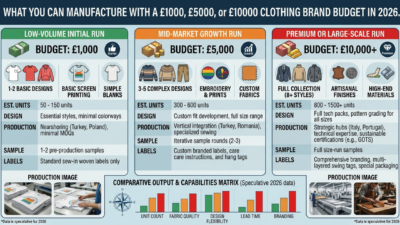
With $1,000 you can launch a print-on-demand brand or a tiny 30-piece test run of one simple product. With $5,000 you can manufacture a real small-batch capsule of two to three styles. With $10,000 you can produce a proper first collection of three to five styles with branding and a marketing budget behind it. The difference between the tiers is not just quantity; it is how much risk you take and how much room you leave to learn.
Most guides tell you what it costs to start a clothing brand. This one answers the reverse and more useful question: you have a specific clothing brand budget, so what can you actually make with it? Below is the honest breakdown for each tier, including the hidden costs that eat into every budget and a framework for stretching whatever you have further.
Key points at a glance:
- $1,000: print-on-demand, or a 30-piece single-product test run
- $5,000: a small-batch capsule of two to three simple styles, roughly 100 to 200 total units
- $10,000: a first collection of three to five styles, roughly 250 to 400 total units, plus branding and marketing
- Hidden costs (sampling, duty, marketing) take a real bite from every tier
- A low 30-piece minimum order quantity is what makes the $1,000 and $5,000 tiers viable
- The smart path is to validate at a low tier, then reinvest revenue into the next
What You Can Manufacture With $1,000
At $1,000, your goal is not to build a collection. It is to test one idea with the lowest possible risk. You have two realistic paths.
Path one: print-on-demand. You design graphics, a third party prints them onto blank apparel only when a customer orders, and you never hold inventory. This is the lowest-risk way to test designs. Your $1,000 goes toward design, a Shopify store, mockups, and a small amount of marketing. The trade-off is thin margins (15 to 30%) and limited control over fabric and fit.
Path two: a 30-piece test run. With a manufacturer that offers a 30-piece minimum order quantity, you can produce one simple product, a t-shirt, a basic hoodie, at genuine small-batch quality. A run of 30 simple tees at roughly $8 to $15 landed can fit inside this budget, leaving a little for basic branding. You get a real, branded product to sell or use for validation, though there is almost nothing left over for marketing.
What $1,000 does not buy: a multi-style collection, custom-developed patterns, or a marketing budget on top of production. At this tier, pick one product, keep it simple, and treat the run as a paid experiment. As industry data shows, roughly 20% of small businesses fail in year one according to the U.S. Small Business Administration, and overcommitting a tiny budget is a fast way to join them. For the full cost logic, see our clothing brand startup costs study.
What You Can Manufacture With $5,000
At $5,000 you cross from testing into building. You can manufacture a real small-batch capsule, but only if you respect the hidden costs first.
Here is honest math. Before product, set aside roughly $500 to $1,000 for sampling (samples run $50 to $200 per style and you often need two rounds), a few hundred for branding and labels, and a small marketing reserve. That leaves roughly $3,000 to $3,500 for actual production.
With that, you can realistically manufacture:
- Two to three simple styles (for example a tee, a hoodie, and shorts)
- Roughly 100 to 200 total units across those styles at a 30 to 50 piece minimum each
- Basic custom branding: woven labels, hang tags, and simple packaging
The key at this tier is simplicity. A simple garment carries a lower MOQ and lower unit cost than a structured one, so a capsule of tees, hoodies, and shorts stretches much further than a single complex jacket would. This is also the tier where choosing a manufacturer with genuinely low minimums matters most, because a factory demanding 200 units per style would consume your entire budget on one product.
What $5,000 does not buy: a large marketing campaign, complex outerwear, or a deep size run across many colorways. Keep colorways minimal, since each color multiplies your minimum.
What You Can Manufacture With $10,000
At $10,000 you can launch a proper first collection with money behind the launch, not just the product. This is the tier where a brand starts to look and feel real to customers.
After reserving roughly $2,000 to $3,000 for sampling, branding, photography, and an initial marketing budget, you have around $7,000 for production. With that you can realistically manufacture:
- Three to five styles, potentially including one more complex piece
- Roughly 250 to 400 total units across the collection
- Proper branding: custom labels, tags, packaging, and professional product photography
- A first marketing push, since customer acquisition in fashion runs $25 to $50 per customer according to Shopify data, meaning $2,000 to $3,000 buys your first wave of customers
This is enough to test a real brand concept rather than a single product, while keeping quantities controlled. The Adstronaut 2026 data notes the hidden costs that erode the cheaper-unit math at this level: sampling rounds, inbound freight, import duties of 12 to 32% for US apparel, and online apparel return rates of 24.4% per the National Retail Federation. Budget for these, and $10,000 comfortably delivers a credible first drop. For a product-specific path, our best hoodie manufacturers guide shows what this budget buys in a single category.
Clothing Brand Budget Tiers at a Glance
| Budget | Best Model | Styles | Approx. Units | Marketing Budget | Risk Level |
|---|---|---|---|---|---|
| $1,000 | POD or single test run | 1 | 0 (POD) or ~30 | Minimal | Lowest |
| $5,000 | Small-batch capsule | 2-3 | 100-200 | Small | Moderate |
| $10,000 | First collection | 3-5 | 250-400 | Meaningful | Higher, more upside |
Unit counts are illustrative estimates based on simple garments at low minimums and typical 2026 landed costs. Complex garments, extra colorways, and premium fabrics reduce the counts. Figures assume production with a low-MOQ manufacturer.
The Clothing Brand Budget Multiplier Framework (Original)
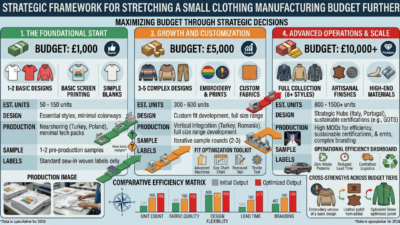
Whatever your clothing brand budget, these five moves make it produce more. Think of them as multipliers on the money you have.
1. Cut styles, not quality. Two excellent styles beat five mediocre ones. Every extra style multiplies sampling, minimums, and photography. Concentrate your budget.
2. Choose the lowest minimum, not the lowest unit price. A 30-piece minimum at a slightly higher unit price almost always beats a 300-piece minimum at a lower price, because unsold inventory costs more than the per-unit difference.
3. Keep colorways to one or two. Each colorway is a separate minimum. Three colors triples your order before you have sold anything.
4. Use stock fabric. Custom-dyed or custom-knit fabric triggers a separate mill minimum. Stock fabric keeps your budget on the product, not the raw material.
5. Validate before you scale. Sell through a small run before ordering a large one. The brands that survive almost always test at a low tier, then reinvest revenue into the next, rather than betting the whole budget on an unproven design.
This framework is an original planning tool. Apply all five and a $5,000 budget can produce what a poorly planned $10,000 budget would.
The Hidden Costs That Shrink Every Budget
No matter your tier, these costs come out before you see a single finished garment. Plan for them or they will surprise you.
Sampling runs $50 to $200 per style and usually takes two rounds. Import duties for US apparel run 12 to 32% depending on fabric and origin, and rose sharply in 2026. Inbound freight adds a few dollars per unit. Marketing to acquire customers runs $25 to $50 each. And returns average 24.4% for online apparel. The founders who fail are rarely the ones who picked the wrong product; they are the ones who forgot these costs existed and ran out of money mid-launch. Our full cost breakdown maps every one of these against a real launch budget.
Frequently Asked Questions
Can you start a clothing brand with $1,000?
Yes, you can start a clothing brand with $1,000, but your model must match the budget. The two realistic options are print-on-demand, where a third party prints and ships on order so you hold no inventory, or a small 30-piece test run of one simple product like a t-shirt with a low-minimum manufacturer. What $1,000 will not cover is a multi-style collection with a separate marketing budget. At this level, the goal is to validate one product idea at the lowest possible risk, then reinvest any revenue into a larger run.
What can I manufacture with a $5,000 clothing budget?
With $5,000 you can manufacture a small-batch capsule of two to three simple styles, roughly 100 to 200 total units, with basic custom branding. After reserving around $1,000 to $1,500 for sampling, labels, and a small marketing reserve, you have roughly $3,000 to $3,500 for production. The key is keeping styles simple and colorways minimal, since complex garments and extra colors each raise your minimum order quantity. A manufacturer with 30 to 50 piece minimums is what makes this tier produce a real capsule rather than a single product.
Is $10,000 enough to start a clothing brand?
Yes, $10,000 is enough to launch a proper first collection. After reserving $2,000 to $3,000 for sampling, branding, photography, and initial marketing, roughly $7,000 goes to production, which can manufacture three to five styles and around 250 to 400 total units. This tier lets you test a real brand concept with money behind the launch rather than just the product. It is often considered the threshold where a manufactured line, as opposed to print-on-demand, becomes practical while keeping quantities controlled.
How many units can I get for my budget?
As a rough guide using simple garments at low minimums and 2026 landed costs, $1,000 produces around 30 units of one product or a print-on-demand model with no inventory, $5,000 produces roughly 100 to 200 units across two to three styles, and $10,000 produces roughly 250 to 400 units across three to five styles. These are estimates. Complex garments, premium fabrics, and extra colorways reduce the counts, while simple tees at high volume increase them.
What is the cheapest way to manufacture clothing?
The cheapest way to manufacture clothing with real inventory is a small-batch run with a low-MOQ manufacturer, using simple garments, stock fabric, and one or two colorways. Print-on-demand is cheaper to start because it carries no inventory, but its per-unit margins are much thinner. For a founder who wants real branded product at the lowest total cost, a 30-piece run of a simple garment from a manufacturer offering low minimums is usually the most cost-effective entry point.
Should I use print-on-demand or manufacturing for a small budget?
Use print-on-demand to validate designs with zero inventory risk, then move your two or three best-selling designs into manufacturing for better margins and quality once you know what sells. Most brands that scale do both, in that order. Print-on-demand suits a sub-$1,000 test phase, while a $5,000 or $10,000 budget is where small-batch manufacturing becomes worthwhile because the improved margins and product quality start to matter.
Why does minimum order quantity matter so much for a small budget?
Minimum order quantity is the single biggest factor in what a small budget can produce, because it determines how many units you are forced to buy per style. A factory requiring 300 units per style would consume a $5,000 budget on one product, whereas a 30-piece minimum lets the same budget cover two or three styles. For budget-constrained founders, choosing a low-MOQ manufacturer is what makes a small-batch capsule possible at all, which is why it matters more than a marginally lower unit price.
Sources and Methodology
Information in this guide is compiled from the following sources:
- U.S. Small Business Administration, small business survival data
- Adstronaut, 2026 clothing brand cost data
- National Retail Federation, apparel return rate data (2026)
- Shopify, fashion e-commerce customer acquisition cost analysis
- Top Growth Marketing, Your Next Store, and Plucky Reach 2026 cost guides
- Wears For You first-party manufacturing data (Sialkot, Pakistan)
Methodology note: Unit counts per budget tier are illustrative estimates based on simple garments at low minimum order quantities and typical 2026 landed costs, not measured averages. Actual output varies with garment complexity, fabric, colorways, and manufacturer. Wears For You’s 30-piece minimum is first-party data.
Whatever your clothing brand budget, the manufacturer you choose decides how far it goes. At Wears For You, our 30-piece minimum per style with flexibility for new brands is built specifically to make small budgets produce real product, whether you are testing one design at the $1,000 level or launching a full collection at $10,000. We manufacture custom apparel from Sialkot, Pakistan with in-house decoration and direct WhatsApp communication. To find out exactly what your budget can produce, contact us for a quote or message us on WhatsApp.